

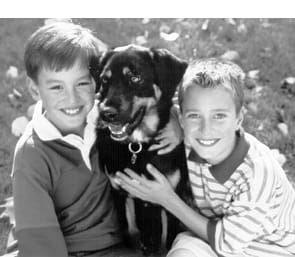
There are few things quite as disconcerting as having your own dog bite you. I can recall with crystal clarity the time our Scottie nailed me in a classic case of redirected aggression. He had taken an intense dislike to a Labrador Retriever who had entered the room, and when I touched him on his back to try to distract him, he whirled around and redirected his aroused state, and his substantial Scottish Terrier teeth, at my hand.
Despite the horror stories of free-roaming Pitbulls mauling children as they walk to school, the majority of dog bites occur in the owner’s home. The majority of dog bite victims are friends or members of the owner’s family. Sixty-one percent of dog bites occur in the home or a familiar place, and 77 percent of bite victims are family members or friends, according to attorney Kenneth Phillips, who specializes in dog bite cases. A relatively small percentage of bites are inflicted by errant stray dogs. This means that most bites leave a shocked owner feeling betrayed by his loyal canine, and wondering whether he can ever trust his four-footed friend again.
Why Do Dogs Bite?
Why did your sweet dog bite you? All dogs can bite, and given differing circumstances, all dogs will. Although we humans regard any bite as aggression, for dogs, biting is a natural and normal means of canine communication and defense. It’s actually surprising that our dogs don’t bite us more often than they do!
Aggression and bites are generally caused by stress, which can come from a variety of sources. Some dogs have high bite thresholds – it takes a lot of stressors to make them bite. Some have low thresholds – it doesn’t take much to convince them to bite. A dog with a high bite threshold may seem like the best choice around kids. This is often true, but if noisy, active children are very stressful to the dog, even a high-threshold dog might bite them. Conversely, a dog who has a low bite threshold may be a fine child’s companion if children are not one of his stressors, and if he is kept in an environment that is free of the things that are stressors for him.
Pain, fear, anxiety, arousal – any kind of threat to the dog’s well-being can be considered a stressor. A timid dog whose space is trespassed upon will retreat, but if prevented from retreating, will bite out of fear. A mother with pups whose space is trespassed upon may feel threatened by the intrusion, and bite. A resource-guarder bites because he is offended (stressed) by his perception that the human might take a possession. The bite often resolves the situation for the dog and relieves his stress, which is why a dog may bite in one instant and seem fine the next. When the resource-guarder bites, the human (generally) withdraws; with the threat to his food bowl gone, the dog is perfectly calm and happy again. Wounds to the human victim’s skin often heal far more quickly than the breach in the relationship between dog and human. This is unfortunate, because the majority of bites are perfectly justified – from the dog’s point of view – although often misunderstood by the human.
If humans better understood dogs, we would realize it’s about behavior, not trust. Many biting dogs could easily remain in their homes and lead long and happy lives, with a low risk for a second bite, if their owners only understood how to identify and minimize their dogs’ stressors.
What to Do If Your Dog Bites Someone
If your dog bites, you have at least four options:
- Manage his behavior to prevent him from ever biting again
- Implement a comprehensive behavior modification program
- Rehome the dog
- Have the dog euthanized
1. Manage his behavior to prevent him from ever having the opportunity to bite again.
While difficult, this is possible. It means greatly restricting his movements so he has no access to humans, other than adult family members. If company comes over, the dog is crated in a closed room. If the grandkids visit, he is crated or sent to a kennel that is equipped to safely handle a biting dog. Even if he adores the grandkids, the fact that he has bitten puts them at unacceptable risk. Unless you are 100 percent confident that you know what his stressors are and can prevent them from occurring during the kids’ visit, you cannot take the chance.
Of course, selecting this option means a reduced quality of life – no more walks in the park, on or off leash; no more rides in the car; and no more spending hours on his own in the fresh air and sunshine in the fenced backyard.
2. Manage his behavior to prevent him from biting while you implement a comprehensive behavior modification program. This requires a serious commitment.
If your dog’s behavior is relatively new and mild, you may be able to accomplish this on your own. (See “4 Steps to Modify Aggressive Dog Behavior,” below.)
Most owners, however, need the (sometimes costly) help of an experienced, positive behavior counselor or behaviorist to help them succeed. The behavior professional will help identify your dog’s stressors, and set up a program to use desensitization and counter-conditioning to convince him that the things he now perceives as “bad” (stressors) are really “good.” If he changes his perception, they will no longer cause him stress, and they won’t push him over his bite threshold.
This doesn’t happen overnight. The longer your dog has practiced his aggression responses, the longer it takes to modify them. The more committed you are to working with him, the more opportunities he will have to reprogram his responses and the faster it will happen. Meanwhile, he must be crated or kenneled while visitors or grandkids are at the house, and not taken for walks, car rides, nor left to his own devices in the backyard.
3. Rehome him with a new owner who is willing and able to do one of the first two.
Rehoming a dog that bites is a long shot. Depending on the circumstances of the bite and the dog’s general nature, some dogs who have bitten may be accepted into training programs for government drug or bomb-sniffing dogs, or as police K9 units. Your average adoption home, however, is no better equipped than you to make the commitment necessary to safely keep a biting dog. Most rescue groups will not accept dogs who have a history of biting, and shelters that do accept them will often euthanize, rather than take the risk (and the liability) of placing them in a new home.
If you rehome him yourself, you risk having the dog fall into the hands of someone who will punish him severely for biting, or otherwise not treat him well. You may even continue to bear some liability, moral if not also legal, should the dog do serious damage to someone at his new home.
There are millions of dogs looking for homes who haven’t bitten anyone. You love your dog and are trying to rehome him. What are your chances of finding someone to adopt him who is willing to take the risk of bringing home a biting dog?
4. Have the dog euthanized.
This is never a happy outcome. Still, you need to think long and hard about this dog’s quality of life. If you can only manage his behavior, will he be happy, or miserable, being shut out of the activities he loves? Can you guarantee that the home you find for him will treat him well? Once a dog bites, will he bite again?
If you can manage and modify, and still maintain your own quality of life as well as his, by all means, that is the best choice. But if not, remember that aggression is caused by stress, and stress is not an enjoyable state of being. If the dog is so stressed that you can’t succeed in managing and modifying his behavior and he is a high risk for biting someone else, he can’t be living a very enjoyable life. Nor can you! As difficult as the decision may be, it is sometimes the right and responsible one for the protection of all of your loved ones, including the dog.
What you should never do is close your eyes and hope and pray that he doesn’t bite again. You are responsible for protecting your family as well as other members of your community. Denial will only result in more bites.
TREATING A DOG BITE: WHAT TO DO IF A DOG BITES YOU
What NOT to Do When a Dog Bites
The most dangerous course of action – for the dog and the human – is also the one taken by most uninformed owners of dogs who bite. Many people react to their dog’s bite by physically and sometimes severely punishing the dog into submission. Some dog trainers even recommend this method, to be employed at the dog’s first sign of aggression. A warning growl or snarl is met with a harsh verbal correction and a leash jerk, followed by more serious measures such as hanging or helicoptering if the dog continued to resist. While this method does manage to “whip” some dogs “into shape,” others will escalate their resistance, fighting back until dog, human, or both, are seriously injured or even dead. You should NOT punish a dog for biting.
This method may also teach the dog not to give a warning prior to the bite. It certainly doesn’t do anything to minimize the dog’s stressors. If anything, it increases the stress, since the dog now associates a severe beating along with whatever other negative feelings he has about the stressor.
Let’s say, for example, a dog is not fond of children. A child approaches and the dog growls – his attempt to let us (and the child) know that her presence is stressful to him. We jerk on his leash and tell him to knock it off. He snaps at us in response to the jerk, so we punish him harder, until he stops fighting and submits. The end result is a dog who isn’t any happier about being around small children, who has now learned that it isn’t safe to growl. This dog is now more likely to bite a child next time he sees one, rather than growling to warn her away, since he has learned that his growling makes us unreasonably aggressive. We may have suppressed the growl, but we haven’t helped him feel any better about being around kids!
A growl is a good thing. It tells us that our dog is nearing his bite threshold, and gives us the opportunity to identify and remove the stressor. Snarls and air-snaps are two steps closer to the threshold – our dog’s last-ditch attempts to warn off the stressor before he is forced to commit the ultimate offense: The actual bite.
If your dog growls or snaps frequently, you need to take notice. He is telling you that there are lots of stressors pushing him toward his bite threshold. If you don’t take action, chances are good that he will eventually bite. And if your dog bites a child – then what? Let’s just say dogs who bite tend to have short lifespans.
Dog Bite Classifications
Well-known veterinarian, dog trainer, and behaviorist Ian Dunbar has developed a six-level system of classifying bites, in order to make discussions of dog biting behavior more consistent and understandable. Those levels are:
Level 1 Bite
Harassment, but no skin contact. This is the so-called snap. Don’t kid yourself. A snap is an intended “air bite” from a dog who did not intend to connect. He didn’t just “miss.” It is a lovely warning signal, telling us that we need to identify his stressors and either desensitize him or manage his behavior to avoid exposing him to the things that cause him undue stress.
Level 2 Bite
Tooth contact on skin but no puncture.This is from a dog who wanted to bite but didn’t break skin, and a warning that this dog is serious. It’s a very good idea to remove the dog’s stressors at this point, before he graduates to the next level.
Level 3 Bite
Skin punctures, one to four holes from a single bite (all punctures shallower than the length of the canine tooth).
Level 4 Bite
One to four holes, deep black bruising with punctures deeper than the length of the canine (which means the dog bit and clamped down) or slashes in both directions from the puncture (the dog bit and shook his head).
Level 5 Bite
Multiple-bite attack with deep punctures, or multiple attack incident.
Level 6 Bite
Killed victim and/or consumed flesh.
Can a Dog Who Bites Be Rehabilitated? Dog Biting Can Usually Be Improved
The good news is that relatively few dogs are beyond help. If you make a commitment to helping your dog feel more comfortable with the world, there’s a good chance you will succeed. You will understand why he has bitten in the past, and be able to avoid his stressors while you work to convince him that what are now stressors for him are actually good things.
Like my own encounter with my Scottie’s capable canines, you will realize that the bite wasn’t personal, but simply the end result of a chain of events that were beyond your dog’s control. What a proud day for you both, when you can take him out in public with confidence, knowing that he is as safe as any dog can be in the face of the unknown elements of the real world.
Four Steps to Modify Aggressive Dog Behavior
Aggression is a classically conditioned response. Your dog does not generally take a seat and ponder whether he is going to bite the next time you try to clip his nails or remove him from the bed. When a stressor occurs, it triggers an involuntary reaction – the dog’s brain screams, “Nail clipping – BAD!” and the dog bites. If you want the dog to stop from biting when you clip his nails, you have to change his brain’s reaction to “Nail clipping – GOOD!” See how disciplining a dog for biting is counterproductive yet?
You will use food, a very powerful positive reinforcer, to change the way your dog’s brain responds to a stressor, using “desensitization and counter-conditioning” (D&CC). Here is one possible program for a dog who bites during nail trimming, as an example. You can change the steps to fit any situation that typically causes your dog to bite.
NOTE: Because the risks associated with a failed program for aggression are high, I strongly recommend that you work with a competent positive behavior professional to implement a D&CC program. The following program is not intended to take the place of professional guidance.
1. Write down every step of the process.
Record every single step you normally take for nail trimming, (or whatever situation your dog has problems with). Your list may look something like this:
a.) Set the nail clippers on the coffee table
b.) Grab dog
c.) Drag dog to coffee table; keep stranglehold of dog’s collar
d.) Grip dog in unbreakable headlock
e.) Pick up clippers
f.) Pick up dog’s right front paw with the left hand while maintaining headlock
g.) Move clippers toward paw
h.) Touch paw with clippers
i.) Clip first nail
j.) Clip second nail, etc., all the way through all the dog’s nails.
2. Determine how to separate different elements of this procedure into separate goals for Desensitization and Counter-conditioning.
Separate goals might look like this:
a.) Develop positive association with clippers
b.) Teach dog to sit quietly and accept paws being held
c.) Convince dog to allow nail clipping
3. Create a mini-D&CC program for each separate element.
Work on each program separately but concurrently so you can put them all together later.
a.) Positive association with clippers. Purchase several nail clippers. Leave them around the house next to his dinner bowl, on the coffee table, etc. Carry them in your hand as you go about your daily routine. Feed the dog treats while you are holding the clippers. Teach him to touch the clippers with his nose for a high-value reward. (This training technique is called targeting.) Pet him with the clippers in your hand and feed him treats.
b.) Teach your dog to accept paw-holding. Have dog sit quietly with you. Touch him at a point that does not elicit tension – perhaps the top of his head. Feed him a high-value treat. Repeat several times, giving him a treat each time, then move your hand slightly down his neck and feed him a treat.
Repeat this process, giving him treats all the while, very gradually moving down to his elbow, his knee, his paw. It may take several sessions just to get to his elbow. If at any time you elicit signs of aggression – a growl, snarl, or snap – you have moved too quickly. An ideal D&CC program never elicits the behavior you are trying to eliminate. Continue this gradual process until you can lift each paw and hold it longer and longer without resistance.
c.) Convince the dog to allow nail clipping. Your dog now thinks that nail clippers are GOOD and paw holding is GOOD. You must now convince him that the actual clipping is GOOD as well.
Do this gradually. Hold the clippers in one hand while you repeat the paw desensitization step (step 3b) with the other, to show him that paw touching in the presence of clippers is also good. Be generous with your high-value treats. Then use the hand with the clipper to repeat step 3b until he is happy about having you touch his paws with the clipper. Continue by closing the clippers near his toenail, then against his toenail, then by actually clipping the very tip off one nail.
4. NOW STOP!
If he handled this well, it is tempting to go on to the next nail, but it is important that you stop here. One nail clipped without resistance is a huge success. Don’t spoil it by pushing him into feeling stressed, and undoing your work.
Repeat the process the next day, and if all goes well, clip the next nail. The third day, if he still does well, try clipping the next two nails. Eventually, when he is comfortable with the whole process, you can sit down and clip all his nails in one session, without risk of being bitten.
To minimize your dog’s other stressors, make a complete list of all you can identify, then create and apply a program such as the one above to desensitize and counter condition him to each. There may be some stressors for which this is impossible, but remember that the more stressors you desensitize him to, the more likely it is that he will spend the rest of his life bite-free.



I, am going through a tough situation and need advice. One of My Neighbors friend asked if someone would like an American Bulldog. My Son had Prior, to being informed, had spoken to our neighbor of loving bulldogs (his dog (My Sons dog, had passed away a while back, and had been sad). My Son asked Me if I was Okay with having a dog at our apartment and of course, wanted him to be happy. The prior owner wanted a good home for her, she was moving to a different city. We got her, she was trained to go outside for her rr duties, sits down and gives her paw, loves the rub the belly… Awesome! Then One day she I think was excited and kind of jumped on me, growled and kind of bit my arm… then a few days later, My son came to My room and i saw blood, I thought he was joking and informed Our dog bit him, I was in shock. Immediately called 911. He had to get stitches and the cops and the Animal Control came, informed of having her Quarantine for 10 days (she has her vaccinations in tact), My Son did not want her to be taken. I didn’t understand, so she stayed and I went to the ER. The Next day, I asked them to pick her up, just to have her know she did wrong. Then My Son told Me, He does not remember if it was a bite or scratch. Oh My Gosh! Well… After the day before last of quarantine (I, wanted her to be evaluated), We went to see her, she had never barked as loud, It hurt ME Sooooo Bad, She is like a daughter to Me, Brightened both Our Life. I, Promised her We were going to pick her up the next day. We were inquiring of where & whom good to have her/temporarily as long as We could keep contact with her…till this day… no one 🙁 We then Picked her up and now have her at a Doggy Spa, I am a single Mother/Dad… It is expensive, Bible. I, am not able to have her back at our place… and wondering is that true? I paid the pet fee and got her evaluated, was informed not bad behavior…Idk What to do….Am I gonna have to find another place to have her or can she still be here. The manager informed she is not able to be here, I’d greatly appreciate feedback, Thank You in Advance. Blessings
My dog and I were on a potty break on our way back home cutting across the drive in apts complex, out of the blue this little old lady and her yorkie bust out of the side of garbage bin! The Yorkie of course is a “happy Yappity- yap-yap-yap snap growl as if it’s any challenge for my Siberian Husky who is the strong silent type! Who suddenly just pins this little thing to the ground! I go to grap her off and I then pull off her collar, now taking off her leash!! Shoot me in the foot! The rest is panic yell at her “ straight to the house” which she obeyed! The little lady stood right in front of my house hold her dog in hand checking her then passing to a noisy neighbor she says “I don’t see anything “ then I just apologize and tell her if needed take her to vet, I will pay for my part of responsibility. All good!
Nope, next day, her daughter is going about the complex slandering me and my dog. Too much to get in too! But it then gets crazy, she’s shoot at me are you the owner of the killer dog? I said , “no”. But if you are referring to the incident yesterday let’s talk. She then states I have nothing to talk to you about! She then begins with treats and taking pictures of me my car and my dog. I had to just go for a ride! So now, I’ve spoken to humane society and I am all good they recommend I speak to dog owner not the daughter being that she is combative, disrespectful and slanderous. I have been notified by HOA that she filed complaint with 2 witnesses. D where they came from but Watever . Now, I just need help with writing a response letter to both HOA and owner of Yorkie telling her I won’t be complying with her daughter due to _______(idk) I don’t have a clear mind so I’ve been stuck without any idea on where to start. Anyone know where I can find help with maybe NOLO or form letters, templates. Need to get the ball back in the game!
Appreciate any advise, help.
CyA
If a dog, that’s not my dog bites me, it’s getting punched or kicked.
I have had 6 dogs. 2 have bit me once and only once. A smack to the face, and they never did it again.
Dave, you were lucky. In many cases, hitting a dog simply escalates the aggression — and the next time, the dog is even MORE scared and MORE vicious as he is now afraid you will beat him again.
There is no animal trainer or behaviorist who thinks that “hitting your dog in the face” is a solution to biting or any bad behavior. None.
Keep in mind if he’s aggressive and violent he should be locked up like any other criminal on the street
If my dog bites me or bites someone close to me. I’ll take my gun a shoot him. End of story .
For all I care is that people are more important than animals so don’t get mixed up
My dog is more important to me. If some stranger shot it, I’d probably get my gun and shoot the person who killed my dog.
First things first! Take some English lessons if english is your dogs first language.
@Parok chop Express: I’ve requested the moderator remove your nasty comments. You are a troll.
These are people with a serious problem, and you are mocking their LANGUAGE. Maybe they are not native English speakers. Maybe they are crying and typing on a phone in a big hurry.
In any event, you have NO useful advice nor experiences to share. Go away.
We have a continued issue with our dog being aggressive with other dogs who he for some reason sees as a threat to him or, as he is part German Shepherd part Collie and so a large dog, more so a possible threat to the other dogs we are minding. There is no warning sign other than when he initially will spring or run to the strange dog. Sometimes it only results in no more than a grow, but on 6 or 7 occasions this has escalated to him lunging at the other dog and pinning them down to the ground with his mouth around their throat. Never has this progressed to him actually biting the other dogs. And is ceased when I call him to come away or the owner who is usually nearer has intervened. And as we mind dogs as a small business this is more key than it would be if we didn’t have any commercial involvement. Plus the implications are greater too. I have ordered him a mussle as this seems to be the only way I can prevent any situation, such as mentioned, from occurring again.
@Graham: I believe that aggression ONLY towards other dogs — strange dog (not your other pets) — is relatively easy to deal with.
DO NOT TAKE HIM AROUND OTHER DOGS. Period.
If you go for walks, it has to be in isolated places and always on a very secure leash (NOT one of those “retractable leashes” but a good rope or leather leash, no more than 6 ft long). I’d probably also muzzle him anytime you go outside your own home or yard.
You may have to give up the dog sitting business UNLESS you can keep your own dog completely separate. If your dog attacks or bites a customer’s dog, you are in lawsuit territory and that won’t be pretty.
A muzzle is good, but not enough. He has to be kept away from ALL OTHER DOGS, period. For the rest of his life. (Most dogs can get out of a muzzle.)
My Greyhound (who was never ever vicious towards anyone unless they hit my brother) just bit my brother after my brother tried to give him a kiss but earlier he tried to attack a husky and I can’t understand why I think he might need to get put down and that makes me so sad we have had Yoda for 5-6 years now and it won’t be the same without him and we have his sister too and she will be heartbroken 😔 please please please pray for my baby boy not to have to die. My brother is at the hospital rn with a puncture in his face and neck please pray for Nathan he is only 14 and is autistic 😰😰😰
My daughter’s dog, Tito, is a Yorkipoo, about 4 years old. He has recently started to be aggressive with strangers. He barks (a lot) and jumps up on them. A visitor entered my home that Tito had been introduced to, but Tito barked and jumped on him and caught his teeth on the visitor’s ring when hands were at waist height. He has severe separation anxiety When my daughter leaves Tito with me and his aggressiveness gets worse. How do I curb this aggression when he is staying here and humanely stop the excessive barking.
My mom’s chihuahua has never been mean and tonight I went to move her in the bed so I could sit and she attacked and bit me and then went after my mom cause she tried to stop it she has never done that before. We are not sure what to do??? We need help! She is very protective if someone moves or swings their arm too quickly not sure if it’s because something was done to her by my mom’s ex 🤷♀️ but we love her so much and have had her for 5 years any advice besides putting her down that is absolutely the last resort I want to try and find her stressors so she can be comfortable I know the arm movement or goofing around with someone is one of them she thinks someone is getting hurt.