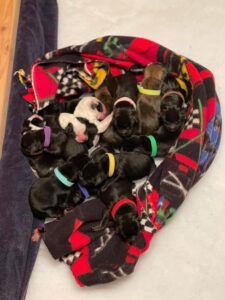
When Emmy VanderMeer offered to foster a pregnant dog for Lucky Lab Rescue and Adoption, she never dreamed the mama would give birth to 15 puppies.
Both VanderMeer and the mother dog, Velvet, spent many sleepless nights feeding the extra-large litter. Velvet nursed while VanderMeer supplemented by bottle-feeding.
Velvet tried her best to be a good mother, but when the puppies started to get those sharp, tiny teeth, it was time to call nursing quits. Eventually, all the puppies were adopted. “Velvet was so happy to see them leave,” VanderMeer says.
VanderMeer’s neighbor, Heather Kyser, adopted Velvet, and VanderMeer adopted Tulip, the runt of the litter.
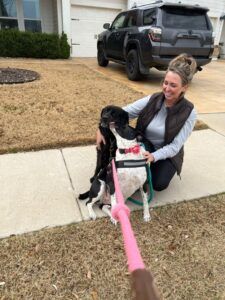
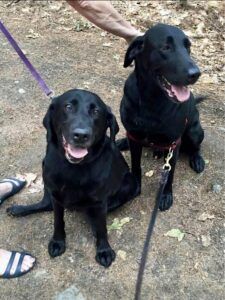
Velvet and Tulip had not seen one another for the last two years, but for this article, the Texas neighbors recently reunited mother and pup, and the meeting went much better than they expected.
“Velvet is very aloof and not welcoming to other dogs typically, but she let Tulip lick her face. That’s huge for Velvet,” Kyser says. “I think after smelling Tulip, she knew there was something familiar.”
VanderMeer also thinks there was a connection. “Tulip is usually a little afraid of unknown dogs, but she wasn’t of Velvet,” VanderMeer says. “I’m not sure if they recognized each other as mother and daughter, but I thought Velvet was very nice to Tulip as compared to other dogs.”
So do dogs remember or recognize their parents? Do dogs know who their parents are? Do dogs remember their puppies? Since animals can’t talk, it’s hard to know for sure, but experts’ best answer is quite possibly.
Do Dogs Remember Their Parents?
Thousands of years ago, dogs’ ancestors, wolves, relied on the ability to recognize their family members.
“Wolves tend to stay in family packs, and since domestic dogs are most closely related to wolves, and these animals live in family packs, it makes sense that dogs may have maintained preferences for close kin and the ability to discriminate them from non-kin,” says Professor Jennifer Vonk from Oakland University’s Department of Psychology in Rochester, Michigan.
In 2015, Professor Vonk and then-graduate student Jennifer Hamilton (now an animal welfare programs manager at the Detroit Zoo) published a study after running experiments to determine whether dogs preferred the scent of their father.
Typically, dog dads don’t stick around to help raise the pups, and in dog rescue, most of the time, papa was likely an unneutered rolling stone who managed to get over a fence.
But in this experiment, the researchers partnered with a service dog organization and worked with pups and their fathers, though the pups never met their fathers in person.
Hamilton collected urine samples from the fathers and from another adult male dog, placed the samples on cloths in vented plastic containers in a clean room, and then welcomed the pups, who were now a year old.
“We just let the dogs in one at a time, and we kind of just let them go and see where they spent their time,” Hamilton says.
The female pups seemed to prefer their dog dad’s scent, while the males were more interested in the scent of the unknown dog.
“This is probably related to territoriality and vigilance, with the determination that their father’s scent was ‘safer’ and less time was needed to explore that scent,” Hamilton says. “This is not a conclusive study, but it does give a lot of evidence that there is a mechanism that dogs can tell who they are related to, and they don’t necessarily have to have lived with them when they were puppies.”
Another study by Peter Hepper, Ph.D., found that young adult dogs who had been separated from their mothers for nearly two years could recognize their mothers and preferred their mother’s scent.
Though anecdotal, other human dog parents report remarkable stories of their dogs recognizing their mothers. Cindy Howes, who lives in Massachusetts, tracked down the mother of her black Labrador, Scout. She arranged a meet-up, and the experience was remarkable.
“They recognized each other immediately,” Howes said. “Scout ran up to her, wiggling and happily wagging his tail. I’d never seen him like that before. He was so happy to see her, and she was so happy to see him! It was heartwarming because he never acted like that before, and never did again, with any other dog.”
But what exactly are the dogs thinking? Though no one can answer that question specifically, researchers have theories.
“We can say they recognize categories of familiar individuals from unfamiliar individuals,” Professor Vonk says. “I think they recognize a familiar individual, and they respond differently to a sense of kin from non-kin. But I don’t know if they’re saying like, ‘That’s my mother, or that’s my sibling.’”
But do dogs, like Velvet, remember their puppies?
Do Dogs Remember Their Puppies?
These days, puppies usually move on from their mothers and get new homes when they’re around eight weeks old, and likely never see their mothers again, unless there’s a special reunion.
So, even after being apart for potentially years, do dogs remember their puppies? Can they tell there’s a connection?
Hepper’s study also found that mother dogs could recognize their pups even a couple of years after separation.
“I think mother dogs can tell their offspring apart from unrelated individuals,” Professor Vonk says. “They probably do treat them differently, because there’s a familiarity there. But I don’t know if they would know, ‘This was a pup from two years ago, and this was a pup from four years ago.’ I’m not sure what level of detail they differentiate them. I think they might just treat all of their pups kind of the same and different from non-pups.”
Professor Vonk’s opinion is similar to VanderMeer’s thoughts after Velvet and Tulip’s reunion. “I think Velvet knew Tulip, but it wasn’t like, ‘Oh my darling daughter,’” VanderMeer says.
How Do Dogs Recognize Their Family Members?
Scent signatures are one of the most significant ways dogs seem to recognize family members. The experiments Hepper, Vonk, and Hamilton ran were all smell-preference tests.
“There’s familiarity, which is you’ve met that individual, so you recognize them as an individual you know,” Hamilton says. “Scent preference has been used in a lot of kin recognition studies in a variety of animals, from fish to voles to squirrels.”
Dogs may also use phenotype recognition to zero in on who belongs to their family tree.
“It’s more, ‘I have an internal idea of who I am and who people related to me are,’ and that is more of a genetic matching for recognition,” Hamilton says. “I think dogs are able to recognize their parents at some level. The challenge is what mechanism they’re using.”
While scientists continue to unravel the mysteries behind so many dog behaviors, we may never be able to fully answer questions like: Do dogs miss their moms? Do moms miss their pups?
But anyone who lives with dogs, cares for them, or watches dog videos on social media can tell you dogs have evolved to the point where their human family members are usually more important than their canine kind.
Though Velvet is Tulip’s mother, Tulip is most bonded with her human mother, who bottle-fed her during the tough times when she struggled to survive.
“Tulip is the baby here,” VanderMeer says. “She is loved and spoiled.”
And that’s all we can wish for all dogs, right?