

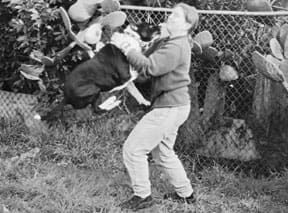
About 85 percent of the time, my Scottish Terrier, Dubhy (pronounced Duffy) is laid-back and phlegmatic. He methodically solves every training challenge I give him (although I don’t expect him to break any speed records on the agility course). His low-key approach to life won our hearts and earned him a permanent home after we found him running loose in a Chattanooga neighborhood in January of 2001 at the tender age of six months. Residents said he had been roaming the area for at least six weeks; a search for his owners proved fruitless. His uneventful introduction to the rest of our pack sealed his fate, and Dubhy joined the Miller family.
Thus his behavior at a Tennessee trainers’ meeting some 16 months later came as a complete shock to me. I arrived early at the Knoxville location, and was sitting on the far side of the training room when fellow trainer Claire Moxim entered with her Labrador Retriever, Pete. Dubhy knew Pete well; they had played happily together at my training center on several occasions.
Dubhy looked up as Claire and Pete entered, then went nuclear, raging and snarling at the end of his leash.
My trainer brain immediately leaped to the obvious “restraint frustration-aggression” conclusion. Here was a dog that Dubhy knew from prior positive play experiences. Dubhy was excited to see Pete, and his frustration at not being able to greet his friend was manifested in a display of aggression. Or so I thought.
“Let’s have them meet on loose leashes,” I suggested to Claire. “Once Dubhy gets to say hi to his pal, he should be okay.”
Fat chance. As Dubhy and I approached Pete on a loose leash, Dubhy did, indeed, seem to settle down. I mistook his controlled behavior for calm behavior. As we came near the big black dog, Dubhy redoubled his hostilities. When I reached down and touched my dog’s hip in an attempt to interrupt his attack, he whirled around and punctured my hand with his teeth in a classic display of redirected aggression. Yikes! Overnight, seemingly without warning, Dubhy had turned into a reactive dog.
Talkin’ ’bout excitation
“Reactive” is a term gaining popularity in dog training circles – but what is it, exactly? In her book Clinical Behavioral Medicine for Small Animals, Applied Animal Behaviorist Karen Overall, M.A., V.M.D., Ph.D., uses the term to describe animals who respond to normal stimuli with an abnormal (higher-than-normal) level of intensity. The behaviors she uses to ascertain reactivity (or arousal) are:
- Alertness (hypervigilence)
- Restlessness (motor activity)
- Vocalization (whining, barking, howling)
- Systemic effects (vomiting, urination, defecation)
- Displacement or stereotypic behaviors (spinning, tail- or shadow-chasing)
- Changes in content or quantity of solicitous behaviors
The key to Dr. Overall’s definition is the word “abnormal.” Lots of dogs get excited when their owners come home, when they see other dogs, when a cat walks by the window, when someone knocks at the door, and so on. The reactive dog doesn’t just get excited; he spins out of control to a degree that can harm himself or others around him. In his maniacal response to the stimulus that has set him off, he is oblivious to anyone’s efforts to intercede. He goes nuclear.
Dubhy has demonstrated reactive behavior in other situations as well. Our neighbor’s black and white cat, Barney, has appointed himself Official Rat Patrol in our barn. Barney’s casual strolls outside our fence send our Scottie into a frenzy; Dubhy runs the fence line like a maniac, barking hysterically and doing stereotypic spins at each corner. When I place myself in Dubhy’s path and wave liver treats in his face I might as well be invisible; he darts around me and continues on his mission. If I let him, he would run himself into heat stroke.
Causes of reactive behavior in dogs
There is definitely a genetic component to Dubhy’s out-of-control level of excitation. If I had researched Scottish Terriers before I decided to keep him, I would have learned that this behavior is actually a desired trait for that breed (see sidebar).
The excuse is that good breeding maintains the original temperament and behaviors of purpose-bred dogs. Labrador Retrievers should be able to retrieve ducks, for example, Border Collies should be able to herd sheep, and Scotties and other terriers should display the pugnacious behavior that makes them good vermin-killers. I had heard this all my life, and was quite familiar with the terrier reputation for feistiness. I now have an intimate understanding of what that really means.
As with most behaviors, environment also plays a role in the responses of reactive dogs. With careful handling, a dog with reactive tendencies may never exhibit the abnormally intense reaction to stimuli that lies dormant in his genes. A dog who could have been a reasonably self-controlled canine in normal conditions, might be induced into reactivity if kept in a highly stimulating environment.
Had I been smarter and realized Dubhy’s propensities earlier, I might not have taken him to doggie daycare, where he experienced a heightened level of stimulation in the presence of other dogs that might have contributed to his Jekyll and Hyde reaction to Pete. He might never have been able to “play well with others,” which he did nicely for over a year, but we might also have avoided the “can’t even control himself in the presence of other dogs” behavior that I found myself dealing with in Knoxville.
Managing your dog’s reactive behavior
Even if you have a highly reactive dog, all is not lost. A reactive dog may be a challenge, but there are things you can do that will help you cope with the stress of living with a dog who tends to flip out. Let’s start with management:
1. Identify his triggers. Make a complete list of all the environmental stimuli that set off your dog’s nuclear reactions. Be specific. For Dubhy that would be: A) the neighbor’s cat flaunting himself on the other side of the fence; and B) some other dogs – mostly those who are taller than Dubhy. Since I can’t successfully predict which dogs will set Dubhy off, I assume all dogs will, and act accordingly.
2. Prevent his access to the stimuli. Change your dog’s environment so his reactive behavior isn’t frequently triggered. For example, you can block his visual access with barriers, control it with training tools, or simply move your dog to another environment when the stimulus is likely to be present.
For Dubhy that might mean: A) asking the neighbor to keep his cat home (which probably won’t happen), or erecting a solid wood privacy fence so Dubhy can’t see the cat, and B) using a head halter when I walk Dubhy in public so I can easily turn him away from other dogs, breaking the visual contact that triggers his reactive behavior.
Modifying reactive behavior in dogs
If you are particularly successful at managing your dog’s environment, that may be all you need to do. Lots of dog owners get by on management without ever retraining the dog. If, however, you’d prefer to change your dog’s behaviors in case your precautions should slip, or if you’d like to be able to relax when you take him out, you can learn to put a behavior modification program in place.
The most powerful tools you can use to reprogram your dog’s reactive responses are classical and operant conditioning. Don’t be frightened off by the technical terms; these behavior modification tools are easy to put into practice.
Say your dog is reactive to people walking their dogs past your house when she is inside, and she barks hysterically and scratches at the windows whenever she sees a dog walking past. You can manage the behavior by closing your drapes, moving the sofa to the other side of the room so she can’t jump up and see out, or putting up a baby gate to prevent her access to the front room. But if you really like having the drapes open, the sofa fits perfectly under the front window, and you enjoy your dog’s company when you are watching TV, you might be more motivated to undertake a behavior modification program to change your dog’s annoying response for the long term.
Think of it this way: There’s a little switch in your dog’s brain that gets flipped whenever she sees a dog outside your window. She likely sees each dog-human pair as a trespassing threat. The instant one appears, her brain kicks into overdrive and she goes nuclear. This is a classically conditioned behavior. She is not thinking, “If I bark hysterically and run in circles, climb the walls and claw the curtains, something good might happen.” Her brain is screaming, “Alert! Alert! Intruders!” and her body reacts accordingly.
Of course, her behavior is reinforced by the fact that every time she does this, the intruders leave. Her canine brain doesn’t comprehend that they would’ve left anyway; she may well think she made it happen. This negative reinforcement (the dog’s behavior made a bad thing go away) only increases the likelihood that the behavior will continue, or even escalate.
This is operant conditioning. In reality, classical and operant conditioning work together all the time to mold our dogs’ behaviors. We use food to operantly condition our dogs to respond to our cues with a desired behavior. At the same time we give our dogs a very positive classical association with the whole training experience because they love food (and playing with us), so they come to love training, too.
To change your dog’s classical association with the presence of a dog walking by from negative to positive, you need to convince her brain (the automatic response part, not the thinking part) that the presence of dogs walking by makes something wonderful happen. This is called counter-conditioning.
Build an unconscious positive association
To succeed at counter-conditioning, begin by preventing your dog’s access to the windows when you are not there so she can’t practice the undesirable behavior. Plan your training sessions for a time of day when you’ll have high traffic past your window. If there is no such time, convince several of your dog-friends to leash their canine companions and – at different times – march back and forth past your window for 15 to 20 minutes. You can take them all out to dinner afterward as a reward!
Be sure your friends know they need to march out of sight in each direction before they turn around. Mark the place on the sidewalk where you want them to turn, just to be sure.
Meanwhile, back at the house, have your dog on leash, using a head halter if necessary. As soon as the marchers come into view, start feeding your dog something totally irresistible, such as tiny morsels of canned chicken. Be sure your dog has noticed the pair before you begin feeding, but don’t wait for her to work herself up into a frenzy. The instant she notices them, begin feeding her. Feed the morsels nonstop as long as the marchers are in view – treats raining from the heavens! As soon as the dog and human passersby are gone, stop feeding your dog. When they reappear and your dog notices them, start feeding her again.
Your goal is to convince your dog that a dog walking by makes chicken happen. You will know you’re making progress when you see your dog notice the walkers and, instead of getting tense and barking, she turns to you with a smile and a “Where’s my chicken?” expression. When she realizes that chicken only happens in the presence of a dog outside the window, she’ll want them to be there, rather than wanting to chase them away.
Build a conscious positive association
When you have successfully changed your dog’s automatic or unconscious association with the stimulus, you can start using operant conditioning to teach her that the presence of the previously offensive stimulus is a cue to sit and look at you.
It’s easier than you might think; just ask her to sit when she gives you the “Where’s my chicken?” look, before you feed her a treat. Slow your rate of reinforcement (how fast you feed treats), and reward her only for the desired behavior, rather than shoveling treats nonstop.
Eventually you can fade the verbal “sit” cue; the mere appearance of a dog walking by your house will become the operant cue for your dog to sit and look at you.
All is calm
Counter-conditioning is definitely more challenging with a reactive dog than with one who responds to stimuli with a normal level of intensity. It may take you longer than it would with a “normal” dog, but it does work. Don’t give up! The more you can saturate the reactive dog’s environment with the concept of “calm,” the more successful you will be at managing and modifying her nuclear reactions.
Help your dog understand that calm behavior is universally rewarded (see “Practiced Calm,” WDJ February 2002). Keep your own interactions with her calm and cool, even when you are tempted to scream at her to startle her out of the high-intensity behavior pattern. Your own intense behaviors are more likely to elevate her energy level than tone it down.
Learn about calming massage, acupressure, and T-Touch™ techniques to help your dog relax. Research herbal, homeopathic, and flower essence remedies to see which ones might be appropriate for your dog. (You may need a holistic veterinarian to help you with this; go to the Web site of the American Holistic Veterinary Medical Association at ahvma.org for a directory of holistic vets in the United States, listed by state, to find one near you.)
It is possible to make progress with a reactive dog. While my Scottie is not yet ready to show off his piano-playing technique at the next big dog trainer conference I attend, I am much more comfortable taking him to relatively small gatherings where other dogs might be present.
We recently helped staff a booth at a fair. Our two-hour stint was uneventful despite dozens of dogs walking by on leash – except for the bad moment when a thoughtless lady allowed her dog to run 25 feet to the end of her retractable leash and get right in Dubhy’s face. I did a quick about-turn with Dubhy to avoid disaster and a setback to his modification program, and then proceeded to explain to the lady why retractable leashes weren’t a good idea in a crowd. She was offended and indignant. I was just thrilled that Dubhy had come so far with his reactive behavior.




This is exactly what I should try. Our girl, runs the fence line line and barks in a frenzy any time a dog walks by.. We have worked with a trainer and are doing exactly what you suggest: blocking access, views. But when my Molly is fixated, it’s like she sees red. Nothing I say/do/offer can get her attention.. Yes, get her attention before she starts running. A lot more work ahead for me!
What if your dog is not food motivated? What is another positive association I can try to make to prevent my dog from reacting? He will take treats when we ask him to sit and stay and stuff like that but as soon as a person or dog is in his line of sight and he is fixated on them he will not take any treats or focus on anything else?
I think the point is to try to get attention before the dog starts to fixate… otherwise it’s too late and the dog has already started to react.
Does anyone have a dog that is reactive to a telephone? Our lab cross goes ballistic when the phone rings to the point of lunging towards the person that is using the phone, sometimes very aggressively. I love him to bits, he is a rescue dog and we have no information about his past. My husband thinks we should rehome him but this would break my heart. He also reacts to excitable behaviour and people raising and waving their arms about, this means he has to be locked away when grandchildren come as he keeps running up to them and barking aggressively.
My reactive Coonhound FLIPS out at the bread machine 🤦♀️ The specific beep it makes and the kneading sound, but the beep seems to bother her more. She’s fine with the beeps on the fridge, dishwasher, toaster oven, instant pot, microwave, etc… The bread machine sends her into a frenzy! 🤷♀️ Never a dull moment… 🥴
I would love to try the modification program and have tried several times but if anyone knows the shih tzu breed they are not food orientated at all – fussy to the point of turning their nose up at what is their favourite treat if not offered when they want it! One of my dogs, shih tzu, came from a breeder than had several pens of dog and every time there was a slight noise they all started barking and whether genetic or not I am sure this played a factor in her first 3 months of life. Now she is like a little ball of anxiety, she will jump/flinch as a drop of water falls from her beard to the water bowl she is drinking out of. She is reactive to most things, bigger dogs, children, prams, bikes, certain people, animals on TV, animations on TVs, certain people on TV and so the list goes on. We started to try to deal with at least the TV situation with various techniques and nothing worked – from treats, ignoring, distraction techniques, desensitizing, toys – nothing has worked – when that “switch flicks” there is nothing that will stop her – she is off, the only thing we can do is as soon as we notice it we we try to switch it over if we can before she notices (not great for TV watching), or simply put a gentle reassuring hand in front of her chest so she can’t pounce off the sofa (often onto our other dog who is asleep on the floor and the complete opposite to her in temperament) and snarling and barking at the TV. So after 5 years – we have resigned to the fact that the best we can do is simply avoid the situations if we can (very difficult when most things set her off) but most importantly keep her safe, never letting her off the lead in public as she is a very small dog with no that switch that means she doesn’t see that huge dog that could swallow her in one bite! Good luck to you all though – I see my Molly as a special needs dogs – she is the most loving and funny little character with all those she knows and feels safe around, so though it is sad she is in such an anxious state a lot of the time – there are plenty of snuggles and fun that are also had x
I have a slightly different reactivity issue with my 4 year old border collie. She’s startle reactive. She sleeps with me (probably my first mistake), and lunges toward me fast if I wake her when I turn over in bed. She jumps up, lunges, and then tries to mouth me. The only thing that works is telling her to sit (she does, thank god) and turning my back to her. Yes, she has bitten me once, but caused no injury.
She is my 5th BC, a spayed female, and none of my previous BC’s have had this kind of issue, let alone any of her other bad behaviors. In fairness to her, she’s had multiple challenges and some trauma (witnessed death in family) in her 4 years, and I’ve learned how to resolve and/or eliminate many of her bad behaviors through counter-conditioning over the past 3 years. But you can imagine how hard it is to protect yourself during one of these episodes when you’re half asleep.
I am a stroke survivor and have peripheral neuropathy in one leg, so this is not a one-off thing. It’s very frequent. Any advice on how I can work to resolve this would be appreciated.
Reactivity comes in so many forms, and I don’t think there is any perfect resolution to this kind of reactive behavior. Maybe my only choice is to lock her out of the bedroom at night.
I adopted my 1 year old doxie/beagle mix Jan 2021. He was reactive to everything-cars, bikes, people, dogs, everything. I’ve had doxies & terriers all my life, but no reactive dogs. I don’t understand why so many trainers act like we regular people have all these friends with dogs to practice with. I’m in my 50s, lost my spouse in March 2020, and live in an apartment complex – reactivity triggers around every corner! By lots of walks & treats he is good with cars & people mostly. I’ve had a trainer come to my home but she kept asking when I could get people & their dogs to help-which was never mentioned in the initial interview. I don’t have a lot of friends & the ones that have dogs I’m not comfortable subjecting them to my dog. Needless to say, I love my pup but I’m getting tired. I don’t have my spouse anymore to “share” doggy duty with and my life is now pretty much work & my dog. The only solutions I can find out there involves sending him somewhere where they use an ecollar-which I refuse to do. I hope it gets better.
I have a year-old labrador mix who I adopted at 6 months. The first month he was amazing and able to sit with me at restaurants and never barked with another dog barked at him. At a year old he is still a loving boy at heart but he lunges snarls, growls, and barks at any dog that he meets on a walk and he can not be in close spaces with any dogs (like in a backyard). I have completely stopped taking him with me to crowded parks or trying to introduce him to friends dogs. No more sitting down at a restaurant or beach days. I get his energy out by walking him alone on less crowded streets at odd times of the day. But it has been very isolating. I am already working with a professional trainer who says I need to treat him like the dog he is. My concern is that his needs are completely taking over my life, as I am doing it alone. Not only financially but emotionally now as well. He is a wonderful support pup when it is just us two, and I have seen him be successful in some situations depending on the other dog and the introduction, but it is so difficult to control when you live in a crowded city. I just want to ask in case anyone has a success story or any advice? I want us both to live a great life side-by-side going on adventures and sharing happy memories but right now it feels like we’re stuck in a cycle of traumatic episodes followed by back to square one.
I have a 1-1/2 old standard poodle who really is perfect in the house, playing with other dogs off leash, with visitors, etc. Barked alot at people in back of our house on the golf course.
However his leash reactivity is so awful. I read and read, hired a trainer, did all the look at me, etc exercises. Tried CBD oil, rescue remedy, etc…didn’t help. Latest is vet put him on Prozac about 5 weeks ago which did calm him down quite a bit, Stopped his barking at people on the golf course near our home. However, if he sees a strange dog when on leash, he still goes beserk barking and lunging. He isn’t at all into treats, even the best types, chicken, etc. Tried distracting him with his favorite toy. Still fixed on dogs when on leash.
I have distanced us by walking the other way, hiding behind bushes, etc whenever possible, but I don’t see him getting any better when he sees a strange dog even if a half block away. Tried gentle leader which gave me more control, but he hated it. Back to harness with clips in front and back…walking fine with that now, but controlling lunging on it is hard for me and I’m afraid he’ll pull me down.
We have not left him overnight since we have him because I know others cannot control him on leash. We cannot visit parks, etc or take vacations with him because he cannot be on leash. Really gets us down. He has been this way since we took him to obedience school at a few months old.
Thank you for this. I have a two year old Scottie who is reactive and has gotten worse during Covid so this gives me hope that I can dampen it. He’s now barking at the TV, previously he used to like to watch the dogs on there so I’ll have to work on this.