
Let’s say you’re winging off to London or Paris or Singapore for several months and want to take your dog along. That’s not a concern if your pup is a legal service dog trained to assist you for a physical, sensory, psychiatric, or intellectual disability: these dogs are allowed by law to ride in the plane’s cabin with their human caretaker, at no extra charge.
That’s not the case, however, for your family pet.
Understanding Dog Shipping
When it comes to shipping a dog by air, one of the most important steps in making arrangements is checking directly with the specific airline you plan to fly with about their requirements. Don’t rely on what you read on the internet: even reliable sources like the Department of Transportation may not have the most current information. Also, these requirements can change quickly and may be very different from airline to airline.
Generally, if you’re flying internationally on a commercial airline, your dog must be small enough to fit in a carrier that can slip under your seat. Some countries—such as South Africa, the UK, and Australia—forbid pets from arriving inside the passenger cabin; if you’re flying to one of these countries, your dog may need to be shipped with a pet transport company.
In fact, it was only recently that most U.S. carriers prohibited dogs from flying in their cargo holds on international flights, although many permit this on domestic flights. A number of non-domestic airlines such as Lufthansa, however, continue to allow dogs in the animal hold on international flights—so again, reach out to your carrier.
How Your Dog Can Fly
There are three ways you can ship your dog by air: they can travel with you in the cabin or as cargo if permitted; you can have your dog shipped through a licensed commercial pet shipper; or you can book your dog as manifest cargo with the same airline but on a separate flight.
So, what about the animal cargo hold? Back when these holds were dank, dark, unpressurized places with no ventilation, heating, or air conditioning, the idea of shipping your dog by air was enough to give any caretaker nightmares. Despite what some people think, however, that scenario is simply not true today.
The animal cargo hold is fully pressurized and climate-controlled, with the same heating and cooling as the cabin; further, pilots can monitor and adjust those systems anytime during the flight. Carriers can, however, apply “seasonal embargoes” that prohibit your dog being shipped as cargo if there’s a chance they will experience temperatures above 85 °F or below 45 °F for more than four hours, or more than 45 minutes during boarding and deplaning.
Risks in the Cargo Hold
While there are always risks in flying your dog—as is true for any of us, human or animal—data reveals that the risk is infinitesimally small. That’s not to say that there’s no risk whatsoever to dogs flying as cargo.
One is related to flat-nosed (brachycephalic) breeds such as Pugs, Bulldogs, Boston Terriers, Pekinese, and Boxers. In fact, many carriers will not allow them to fly in the animal hold at all. Even under everyday circumstances, these breeds are physiologically more prone to respiratory problems due to their anatomy and can also be more vulnerable to changes in air quality and temperature in a plane’s animal hold.
Perhaps the greatest danger comes from pet caretakers trying to do the right thing by sedating their dog before a flight. The American Veterinary Medical Association, the International Animal Transportation Association, and the US Department of Transportation all strongly advise against giving your dog any sedation before a flight. Not only do tranquilizers lower blood pressure, they also suppress the central nervous system and can increase the possibility of heart or respiratory problems. A study from 1995 (Tennyson, A.V. Air transport of sedated pets may be fatal. Journal of the American Veterinary Medical Association, 1995) which is still widely referenced by veterinary experts found that oversedation is the most frequent cause of animal deaths during air transport: from 1990 to 1995, almost half the animal deaths on airlines resulted from sedation.
Age, Weight, and Crate Size Limits
To fly in most passenger cabins, dogs must be at least eight weeks old. Size restrictions vary, but most major airlines limit the combined weight of the dog and carrier to not over 20 pounds. To fit under the seat, carriers should be no more than 19 inches long, 13 inches wide, and 9 inches high; your dog must be able to stand up, turn around, and lie down inside the zipped carrier.
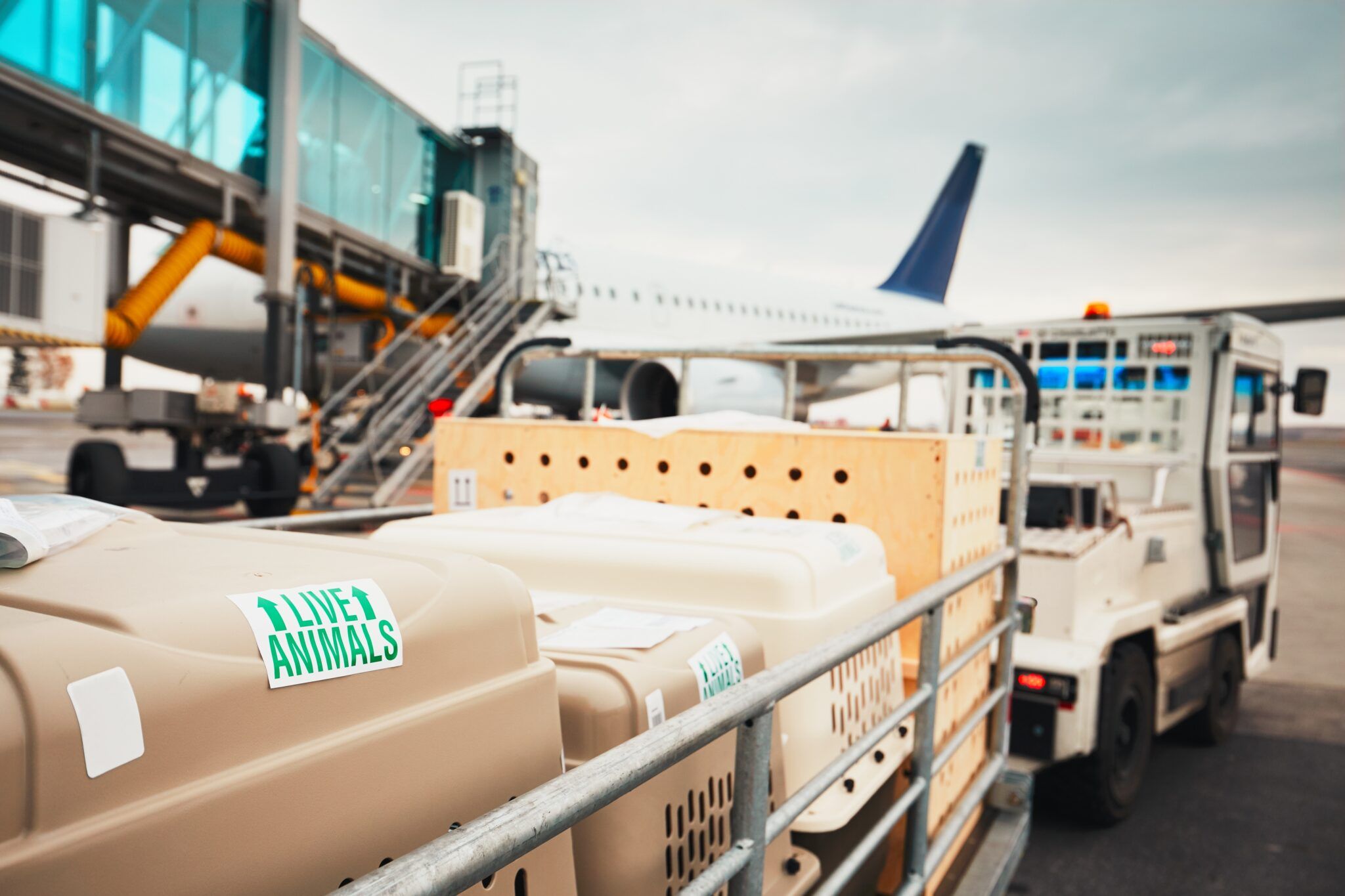
If your dog is flying in a plane’s cargo/live animal hold, crates must meet International Air Transport Association (IATA) guidelines and airline-specific standards. Again, contact the particular carrier for their requirements, but as a rule they will follow IATA standards.
International pet travel arrangements can often take up to six months, so communicate with your destination country’s embassy to determine their entry constraints. If your endpoint is at high risk for rabies, there likely will be additional restrictions; also, certain EU countries may require a rabies titer test. For entry into the UK and EU, your dog must also carry an ISO-compliant microchip.
The USDA’s Animal and Plant Health Inspection Service (APHIS) Form 7001 is one of the most common forms linked to pet travel. This form must be completed by your veterinarian and certifies that your dog is healthy and fit enough for travel. However, each air carrier sets independent transport rules . . . one more reason to talk directly to the airline.
Preparing Your Dog for Travel
Before your trip, do everything you can to minimize your dog’s stress, starting with allowing at least a month for them to become familiar with the carrier or crate. Leave the door open, with a comfortable blanket or crate pad inside. Try feeding your dog inside the carrier to help create a positive association.
Talk with your veterinarian about how long before the flight you can feed your dog, and how much. Make sure the crate or carrier has room for a water bowl, and that your dog has access to water during the flight.
Ensure your pup has a collar with ID tags, as well as an internationally-compliant microchip. Carry a current photograph of your dog. Put your name and phone number inside the carrier and attach a tag showing your destination address. Pack a leash, medications, and emergency information such as contact information for your vet and an emergency veterinary hospital at your destination.
Very few studies have been done on the effects of air travel on the welfare of dogs; much of the available information is based anecdotes and practical experience, rather than research. However, we do know that a dog’s stress level during travel is directly related to the caretaker’s anxiety. After thousands of years of domestication, dogs have become exceptionally attuned to human emotional states, to the point that they often mirror those conditions. Experts also know that about ten percent of dogs experience significant distress during air travel, evidenced by panting, trembling, and whining. Some of this, of course, is caused by unfamiliar sounds, vibrations and airplane movement, and unaccustomed confinement, all of which trigger the release of stress hormones like cortisol and adrenaline. One way to reduce that anxiety is to book a nonstop flight and avoid layovers and busy holidays.
Clearly, more research is badly needed, especially considering the extensive availability of air travel today, and the increasing number of caretakers who travel—whether by air or land—with their dogs by their sides.
If you are considering shipping your dog via a ground transport service, see “Hitting the Road: How to Choose a Dog Ground Transport Service.”