
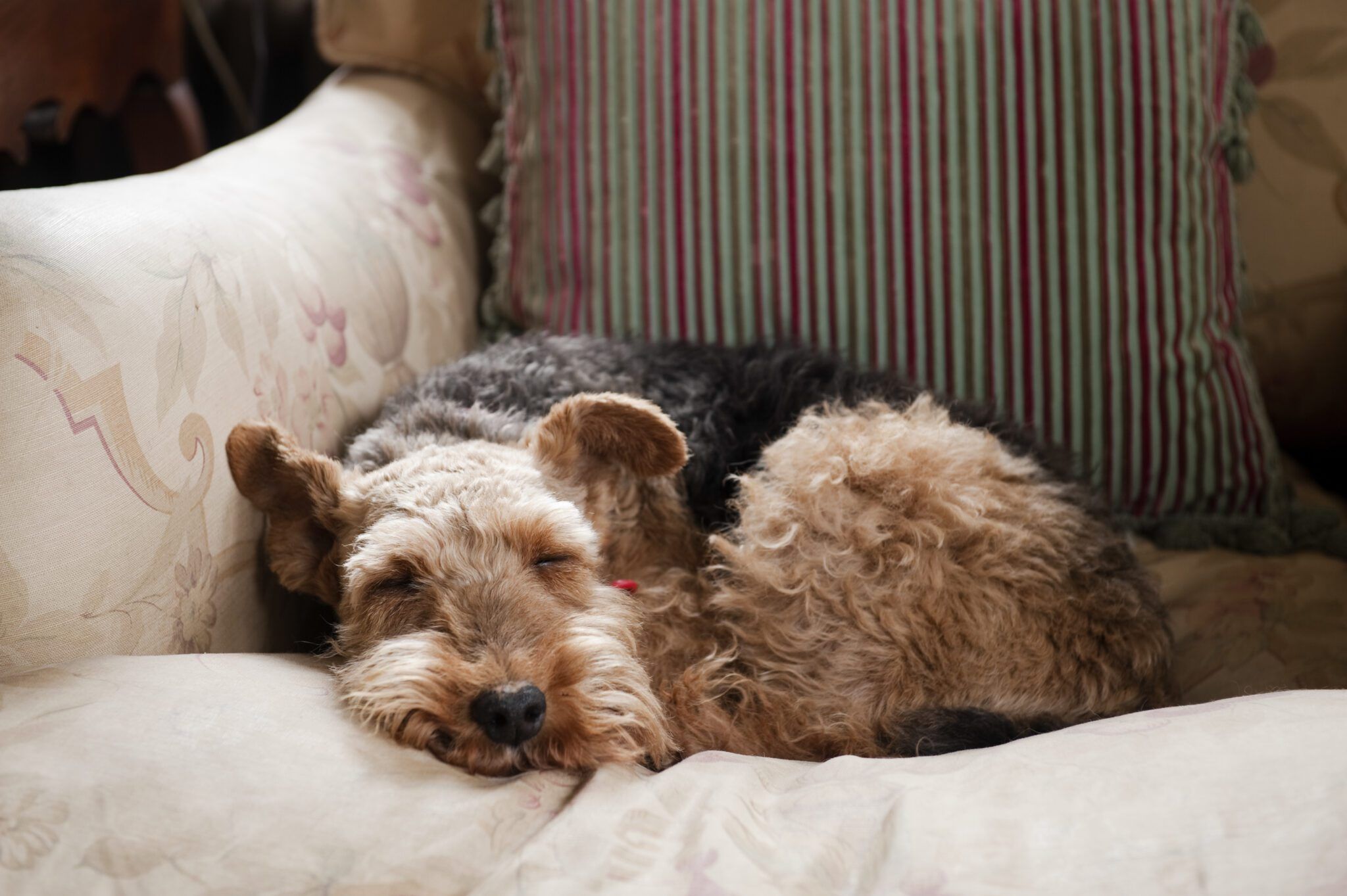
Today, science is leading us in some new and remarkable directions, further blurring the differences between humans and our animal companions. Take sleep, for instance: we know that REM (Rapid Eye Movement) sleep in humans—that highly fluid sleep stage typified by intense brain activity, vivid dreaming, and rapid eye movements —is a critical component of deep sleep. But REM sleep isn’t confined to only humans: signs of it have long been found in dozens of mammals, but more recently in a surprising and expanding group of other creatures: cuttlefish, octopus, rodents, birds, reptiles . . . and even spiders. These new discoveries have prompted some researchers to suggest that dreaming, once believed to be the sole domain of humans, occurs in far more species than we ever thought.
Do Dogs Dream?
Back in the 1800s, the majority of scientists believed that almost all mammals experienced vivid dreams. That vision fell out of favor with the rise of behaviorism in the 20th century, with many scholars poo-pooing the idea that any species other than humans was capable of dreaming.
Today, we know better, and understand more. As Jane Goodall said, “We find animals doing things that we, in our arrogance, used to think was ‘just human.’”
Which brings us to one of our most enduring companion animals, the dog. Watch a dog in deep sleep, and you’ll see him twitching and pawing and barking and whining, and if you look closely, you can see movement behind his lidded eyes. Is he dreaming? If so, what is he dreaming about?
Defining Dreams
First, what is a “dream”? While there is no unified definition of dreaming, the dictionary defines dreams as a series of mental images, emotions, and sensations that occur involuntarily during sleep. Once, scientists believed that dreams arise only during REM sleep, but research over the last 50 years has proven that dreams occur throughout both sleep cycles, although REM dreams tend to be more emotional, vivid, and are longer.
Scientists believe that dreaming is an evolutionary state shared by many species, and serves similar functions such as memory reinforcement, but even they can’t say for certain if our dogs have the same emotional experiences as humans. In many respects their physiology and behavior are similar to ours, leading to the hypothesis that we also share at least some similarities in mental activity, including dreaming.
Exploring Animal Sleep Studies
Yet in most of the 20th century, while a huge body of scientific studies focused on animal sleep, researchers scrupulously avoided the subject of dreams. Many insisted that the idea of animal dreams was simply anthropomorphizing: the assignment of human traits and emotions to non-humans. It wasn’t until the 2020s that the word “dream” began to enter the lexicon of scientific studies on animal sleep, based in large part on research using EEGs (electroencephalograms), which measure electrical activity in the brain. This revealed that during sleep, a dog’s brain wave patterns are almost identical to ours and exhibit the same type of electrical activity.
Signs That Dogs Dream
Just as humans often exhibit physical reactions during dreams by talking, moaning, laughing, and sometimes sleepwalking, dogs also respond subconsciously to their dreams with physical signs: twitching their paws, wagging their tail, whining, grumbling, licking their lips, and sometimes barking. While all of this cannot prove with absolute certainty that dogs are dreaming, it is the clearest indication thus far that they are.
Unless in the far distant future dogs learn to speak (and what, do you think, would they say?), we need to rely on physical cues to tell us. Lest I be accused of that much-dreaded anthropomorphizing, such assumptions are not so far-fetched: with our fellow humans, we take cues from their physical expressions every day: someone is limping, and we presume they have been hurt . . . someone laughs, we believe something was funny . . . someone grimaces when they bend down, we surmise their back is bothering them. Doctors and mental health experts are taught to watch a patient’s body language, teachers base many of their actions on a student’s behavior, and even our clichés—”watch what they do, not what they say”—reveal just how much we rely on physical signals.
What Do Dogs Dream About?
So, if dogs dream, what do they dream about? Do dogs dream about their owners? Food? Chasing rabbits?
We can only theorize, but it appears they dream about their day. For instance, EEG studies done on rats show they dreamed about the mazes they ran earlier: the rats’ brain activity during sleep was exactly the same as their brain waves while they were running through the actual maze. Researchers could even tell precisely where the rats were in their dream maze. If rats dream of past events, then it stands to reason that dogs, who are more intelligent and whose brains are far more complex, must have similar dreams.
It’s also likely that dogs dream of things that are central to their world, such as food, playing, their human companions, and even more fundamental to the way they experience the world, smelling. Dr. David Peña-Guzmán, author of When Animals Dream: The Hidden World of Animal Consciousness, explains that a canine dream would be far different than a human one, because it would be based upon the unique circumstances of a dog’s life. Dogs dream on their own terms, and of their own experiences—and since much of how dogs interact with the world is through their noses, it follows that smell is likely a key component of their dreams (unlike humans, whose dreams rarely if ever include smells). A 2025 study goes further, noting that dogs appear to have emotional responses to scents, which only heightens the likelihood that a dog’s dreams would include smells. Since dogs process life through their noses and eyes rather than logically, their dreams probably integrate imaginative events with common scents and sights.
We also know that dogs are capable of experiencing a wide range of negative feelings, including fear and anxiety. Studies on PTSD in dogs reveal that they develop symptoms similar to humans suffering from the disorder, including sleep disturbances, and that the distress from their trauma manifests in their dreams. For dogs with longstanding trauma, such as those with abusive or neglectful pasts, the likelihood of experiencing nightmares may be even higher.
We may never know for certain what mysteries lie within the quiet whispers of our dog’s dreaming mind, any more than they can know what is in ours—but it’s far from fanciful to believe that their dream life is every bit as vibrant, diverse, and emotional as our own.