

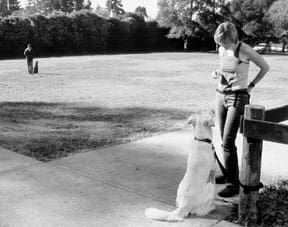
Clients always appear a bit stunned at first when I tell them their dog’s growl is a good thing. In fact, a growl is something to be greatly treasured.
These are my aggression consultation clients, who are in my office in desperation, as a last resort, hoping to find some magic pill that will turn their biting dog into a safe companion. They are often dismayed and alarmed to discover that the paradigm many of us grew up with – punish your dog harshly at the first sign of aggression – has contributed to and exacerbated the serious and dangerous behavior problem that has led them to my door.
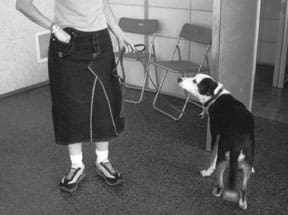
It seems intuitive to punish growling. Growling leads to biting, and dogs who bite people often must be euthanized, so let’s save our dog’s life and nip biting in the bud by punishing him at the first sign of inappropriate behavior. It makes sense, in a way – but when you have a deeper understanding of canine aggression, it’s easy to understand why it’s the absolute wrong thing to do.
A Growl is a Communication Effort
Most dogs don’t want to bite or fight. The behaviors that signal pending aggression are intended first and foremost to warn away a threat. The dog who doesn’t want to bite or fight tries his hardest to make you go away. He may begin with subtle signs of discomfort that are often overlooked by many humans – tension in body movements, a stiffly wagging tail.
“Please,” he says gently, “I don’t want you to be here.”
If you continue to invade his comfort zone, his threats may intensify, with more tension, a hard stare, and a low growl.
“I mean it,” he says more firmly, “I want you to leave.”
If those are ignored, he may become more insistent, with an air snap, a bump of the nose, or even open mouth contact that closes gently on an arm but doesn’t break skin.
“Please,” he says, “don’t make me bite you.”
If that doesn’t succeed in convincing you to leave, the dog may feel compelled to bite hard enough to break skin in his efforts to protect self, territory, members of his social group, or other valuable resources.
Agression is Caused by Stress
What many people don’t realize is that aggression is caused by stress. The stressor may be related to pain, fear, intrusion, threats to resources, past association, or anticipation of any of these things. An assertive, aggressive dog attacks because he’s stressed by the intrusion of another dog or human into his territory. A fearful dog bites because he’s stressed by the approach of a human. An injured dog lacerates the hand of his rescuer because he’s stressed by pain.
When you punish a growl or other early warning signs, you may succeed in suppressing the growl, snarl, snap, or other warning behavior – but you don’t take away the stress that caused the growl in the first place. In fact, you increase the stress, because now you, the dog’s owner, have become unpredictable and violent as well.
Worst of all, and most significantly, if you succeed in suppressing the warning signs, you end up with a dog who bites without warning. He has learned that it’s not safe to warn, so he doesn’t.
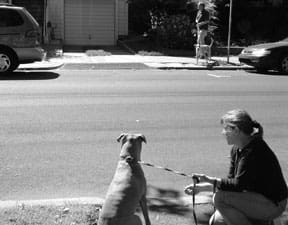
If a dog is frightened of children, he may growl when a child approaches. You, conscientious and responsible owner, are well aware of the stigma – and fate – of dogs who bite children, so you punish your dog with a yank on the leash and a loud “No! Bad dog!” Every time your dog growls at a child you do this, and quickly your dog’s fear of children is confirmed – children do make bad things happen! He likes children even less, but he learns not to growl at them to avoid making you turn mean.
You think he’s learned that it’s not okay to be aggressive to children, because the next time one passes by, there’s no growl.
“Phew,” you think to yourself. “We dodged that bullet!”
Convinced that your dog now accepts children because he no longer growls at them, the next time one approaches and asks if he can pat your dog, you say yes. In fact, your dog has simply learned not to growl, but children still make him very uncomfortable. Your dog is now super-stressed, trying to control his growl as the child gets nearer and nearer so you don’t lose control and punish him, but when the scary child reaches out for him he can’t hold back any longer – he lunges forward and snaps at the child’s face. Fortunately, you’re able to restrain him with the leash so he doesn’t connect. You, the dog, and the child are all quite shaken by the incident.
It’s time to change your thinking.
When Dogs Cry for Help
A growl is a dog’s cry for help. It’s your dog’s way of telling you he can’t tolerate a situation – as if he’s saying, “I can’t handle this, please get me out of here!”
Your first response when you hear your dog growl should be to calmly move him away from the situation, while you make a mental note of what you think may have triggered the growl. Make a graceful exit. If you act stressed you’ll only add to his stress and make a bite more, not less, likely. Don’t worry that removing him rewards his aggression; your first responsibility is to keep others safe and prevent him from biting.
If the growl was triggered by something you were doing, stop doing it. Yes, your dog learned one tiny lesson about how to make you stop doing something he doesn’t like, but you’ll override that when you do lots of lessons about how that thing that made him uncomfortable makes really, really good stuff happen.
This is where counter-conditioning comes in. Your dog growls because he has a negative association with something – say he growls when you touch his paw. For some reason, he’s convinced that having his paw touched is a bad thing. If you start by touching his knee, then feeding him a smidgen of chicken, and keep repeating that, he’ll come to think that you touching his knee makes chicken happen. He’ll want you to touch his leg so he gets a bit of chicken.
Note: Make sure your dog’s discomfort with you touching his paw is not related to pain. If it hurts when you touch him there, counter-conditioning won’t work. It’s a good idea to get a full veterinary workup if there’s any chance your dog’s growling may be pain-related.
When you see him eagerly search for chicken when you touch his knee, you can move your hand slightly lower and touch there, until you get the same “Where’s my chicken?!” response at the new spot. Gradually move closer and closer to his paw, until he’s delighted to have you touch his foot – it makes chicken happen! Now practice with each foot, until he’s uniformly delighted to have you touch all of them. Remember that the touch comes first, so it consistently predicts the imminent arrival of chicken.
If at any time in the process – which could take days, weeks, or even months, depending on the dog and how well you apply the protocol – you see the dog’s tension increase, you’ve moved too quickly. Back up a few inches to where he’s comfortable being touched and start again. Or, there may be other stressors present that are increasing his tension. Do an environment check to be sure nothing else is happening that’s adding to his stress. Have the rowdy grandkids leave the room, give him a little time to relax, and start again.
Remember, dogs can’t tell us in words what’s bothering them, but they can communicate a lot with their body language and canine vocal sounds. Pay attention to what your dog is telling you. Listen with heart and compassion. Be gentle when your dog tells you he needs help. Come to his rescue. Treasure his growl.
-Pat Miller, CPDT, is WDJ’s Training Editor. She is also author of The Power of Positive Dog Training, and Positive Perspectives: Love Your Dog, Train Your Dog. Miller lives in Hagerstown, Maryland, site of her Peaceable Paws training center.




I am wanting to understand the best response to my 16-week-old Doberman puppy that growls when she does not want to get off the bed (our solution is to not pick her up off the bed. This is when she growls. We are only letting her up on the bed for around 1 hour before we go to bed. To address this issue we limit her time in bed at night. When I want her to go to bed in her crate I put treats on the floor so she has to jump off the bed to get the treat. This is how I get her off the bed so she can she sleep thru the night. Do you have any other suggestions? My second situation that she will growl is when she really wants something and she is frustrated. For example tonight we were getting ready for a small group of folks coming over, and she really wanted to be at the table to get food. I think she must have been hungry as dinner was within around 1 hour, and she was very stressed with our stress and all the furniture moving around, etc. So after reading about puppy growling I am thinking that I should of set her up better. She should of been in her crate more to reduce her stress. My take away from the suggestions and other comments that she just needed to have a calmer place to be while we were getting ready. Of course she is with me upstairs while the guests are down stairs. I just felt it would be way too stress for her and disruptive to the guests. Any other ideas on ways to address this type of growling.
I have a 16 month old golden doodle. He has a tendency to jump up, nip(sometimes draw blood) and growl when I walk in the back yard. I try standing still and offer him no attention , but he continues to nip and growl. He eventually stops. When I continue to start walking he starts all over again. Rewarding the behavoir when he stops doesn’t seem to work. I’m not sure what he is trying to communicate. Maybe he wants me to stay out with him. Idk, but I’m frustrated with getting bit in the butt and arms.
My 9week old red nose Pitt bull is growling at my kids when they pics here up for a cuddle.. she growls, snarls and goes for a bite. Or if she’s play fighting with my cat, the kids grab her to get her off him and she growls at them quite aggressively. I’ve always owned these types of dogs, never had one with this much aggression from a young age.. it’s really scary.. any tips?
My dog sam is a rescue German spitz what was neutered a week before I had him he is 5 years old and tries to be the alpha …but I won’t let him be the leader of me .He does tend to lick his bits that have now gone and growls and makes gurgling noises …does anyone know or has the same with their dog ?
Yes I dont know really whats going on w my dog hes a pomeranian mix yorkie who is ten years old n I have him now for almost a whole year see me n a dear friend saved him from being put in a shelter he’s the most sweetest n who is very smart well jus all of a sudden he.growls n becomes very aggressive when im holding him and when my friend comes in the room he starts growling n literly wants to bite her he was never like that towards her hes like her talk also he sleeps in her bed w her she’s the one who feeds him every day why is he doing that????
My 9 mo old puppy we got from a shelter growls whenever my older dog, 12 yr old approaches or even just stands up when the puppy is near us…on our chair, in the office etc. Would the positive training with the chicken work on this situation? It’s getting pretty serious Thank you for your help. Barb
That is a territorial growl from a dominant puppy. The good news is, this behavior is easily trainable, and even easier because it’s a puppy. You’ll have to use a mix of negative and positive reinforcement. Remember, negative reinforcement with a dog is different than negative reinforcement with a human, because dogs are pack animals. Every pack needs an Alpha, and if there isn’t one, your dog will assume that role.
1. Whenever your puppy growls at your older dog, give it a tsk and a firm tap. Not to hurt it, but not soft like you’re petting it, but like if you were tapping a person on the shoulder to get their attention. This is a way of telling the dog that you’re the Alpha of the pack. You must remember to do this all the time.
2. Find a toy or treat that your puppy loves. Have it come to you and sit. Don’t give your puppy the toy or treat. Call your older dog and have it come. If your puppy growls, give it a tap and a tsk, and don’t give the puppy the toy or treat. Instead, give a treat to the older dog. Give it a minute or two, and repeat. If the puppy doesn’t growl, then give the puppy the toy or treat, but only after you give a treat to the older dog, first.
3. Any training you provide, always repeat again a minute later, then 2 minutes, then 5 minutes, then 10 minutes, then 15 minutes, then 30 minutes, etc., until you’re doing this two hours apart for a couple of days. It takes a lot of time and patience.
Our puppy just started this behavior. He is a lab mix. Towards the end of december of 2020, he snapped at me and my wife. He got my wife pretty good, and only barely got me. We are tying to comprehend what the issue is. Just asking for paw makes him mad. He cowers when we tell him to eat his food. I had my hand next to a pair of socks one morning, and he snapped at my hand. How do we positive reinforce when we cant ask him to do anything without him getting upset.
Hi Christopher, I know this post is really old now but I had/have similar issues with our Border Collie. She was showing signs of ‘aggression’ quite early on in getting her. Food was the big trigger. And she was much worse with me. It then started to overflow on many areas. Guarding her bed, her safe spaces (crawling under sofas etc.). I found it particularly upsetting as she was and is more reactive me. We had tried trainers, books etc. but we’re not really getting the results we wanted. Or it would be inconsistent. Trainers were telling us she was aggressive and dangerous and essentially a no hope case. This god I didn’t give up. I finally found a trainer that was worth his weight in gold! And I was making the situation worse with initially being taken aback and fearful. So would punish her (yank on the chain, raised voice, correcting growls, removing her food when when growling). I had no idea that by doing all of this I was just re-enforcing her reasons to growl. She associated feeding negatively and would growl at any movement or noise, because in the past if I was around her she associated me with taking her food away. If I came up on her too quickly she would growl (warn – hey you just came into my space with no warning). I’d then ‘punish her by putting her in her crate and removing any of the positive things she associated with. So I was without knowing, confirming her ‘fear’. Anyway… long story short. It’s not an easy road. And we are still working through the various behaviours. In terms of where to start… make your dog feel safe and while it seems counter intuitive, listen to him/her. Remove yourself from the situation. There are ALWAYS signs beforehand (we are just missing them). So I started with the feeding doing what our new trainer taught us. Instead of bowl feeding and then taking it away if she growled. I had to re-condition her thought of me and her food. So it started with hand feeding. I’d put the food in her bowl. Stand up or sit on a chair (do not go down to the dogs level, you are the leader). Put the food into your hand, show it to her and then close your hand, and position your hand behind you but so close when you open your hand it’s touching you pretty much. She will stare at your hand. Do not move or talk. Just wait her out until she gives you eye contact. Immediately say a one word command (we used yes), then opened my hand and she could approach to eat from my hand. What this is doing, is forcing her to no.1 look at me and acknowledged the food she loves is coming from me. And then saying yes and inviting her into your space to get the food. She must be touching me and in my space. What this is doing, is forcing her to come to you, so she can’t guard. And it then flips that switch, of hey this person is good as I get to eat my food. She is giving it to me, not taking it away. If you get a growl do not get discouraged and do not discipline negatively. Just walk away briefly 20/30 seconds, the energy is calmer and start again. You are not negatively rectifying. You are not saying good girl. You are just doing an exchange. Here is your food or treat, eye contact shows this yummy stuff is coming from me. And only after all is complete you praise and finish off with a high reward treat in the same way (a piece of ham or chicken). I personally sit on a chair and she has to physically have her chest on my thigh while eating food or treat out my hand. If standing out it between your leg, again forcing her touch you while getting this delicious food or treat. It took 6 months… but now she eats calmly from a bowl… not only did I resolve her guarding but it built trust between us. She sees me and associates good things. This person gives me stuff I like. But it’s also controlled by me so I’m higher in the pecking order. Yes it is hard work, but it has helped with 80% of the other issues, as just this feeding exercise built up positive association with me, trust with me, and also pack order without any negative association. I can share videos and give note details if you like. Since I have now done training and behaviour studies, as realised I loved our new relationship and learning about her personality and learning about myself. It was so rewarding… and I love my unexpected new career. And I love my beautifully natured dog who I was told was dangerous and could not be trained. Had I not pushed hard to find some help my now best friend would have been put to sleep. Unfortunately dog training and behaviourists are so unregulated these people can do 1 week course with never touching a dog and be ‘qualified’… don’t give up!!! And no I’m not promoting my services, I will happily help if it means a chance for a happy and healthy dog and dog owner 😊
Excuse my spelling and grammar – phone joys of typing too quickly.
It may not seem like it, but I am English, and very embarrassingly used to be head of communication in marketing roles. Yikes
Excuse my spelling and grammar – phone joys of typing too quickly.
It may not seem like it, but I am English, and very embarrassingly used to be head of communication in marketing roles. Yikes
My dog will growl when he’s focused on something and I try to pick him up. He’s also growled at me when he was cuddling with my BF and I laid next to them and put my hand on the dog he let out a growl. What does this mean? He’s still a puppy and if I can correct this behavior immediately I’d like to.
i have a dog and i dont understand why she is growling she is happy but she shows her teeth and growls but she is happy and she wants to get pet
My uncle has a lab who shows her teeth and growls when she’s really excited, but wiggles and wags the whole time. She’s never been aggressive, and only does it when she’s extremely happy. She rolls on the ground afterwards and begs for belly rubs. I guess some dogs are just wired different.
We got our female, fixed Golden R at 1.5 years of age. She was returned by an older woman who said the dog growled at her alot. Turns out the dog had a man in the prior family and belief was not loved by the woman. The dog claims me, a man, as her favorite, but will allow many things for my wife to do with her. However, mostly at night, when she is will me in the bedroom on the computer and my wife walks in, dog will low growl, get up and go to her with tail wagging, but still low growl and will let wife pet her, but this is extremely irritating behavior for me and and my wife, We definitely believe it is from the dog’s prior life and we cannot get in contact with prior family. The dog does not growl at other family members or neighbors, or strangers, but is very friendly to them. How can we correct behavior to my wife at certain times?