
The decision to add a new dog to the pack shouldn’t be taken lightly. I counsel prospective owners of new dogs to be clear about their needs and preferences rather than making spur-of-the-moment rash decisions, because their success at integrating a new dog into an existing “pack” so often depends on their ability to make informed decisions. These choices include what kind of dog to adopt, how to prepare their home to accommodate the new dog, how to introduce the new dog to the existing household members, and how to incorporate her into family routines.
Bringing a new dog into the family can be fraught with unexpected developments, no matter how experienced a dog owner is, how well her home is prepared, and how good-natured the dogs are that she already owns. I’ve incorporated a new dog into my family dozens of times in my lifetime, counseled hundreds of clients about how to do it, and written a number of articles about it for this magazine (see “New Puppy Survival Guide,” this issue), and I still am surprised by the issues that can arise when a new dog comes home. However, with preparation, flexibility, and dedication to principles of positive training and behavior management, most dog owners can get through the adjustment period with peace in the pack.
Open your heart
I recently had the chance to practice what I preach when the loss of Dusty, our valiant Pomeranian, left a vacant spot in our pack last spring. Dusty had been my almost constant companion for close to 15 years, and though it’s been nearly five months, the pain of his passing is still close to the surface. I often tear up as I think of his dear little fox face and boundless good cheer.
One of the things I do to help ease the overwhelming hurt of losing a close companion is to remind myself that it also means there’s room in our family for another. Without actively looking, I know that a new furry face will one day draw my attention and grab my heart, as surely as if I had hung out a “Vacancy” sign. So it was early this summer, when I was doing behavioral assessments at the Humane Society of Washington County, where my husband, Paul, serves as the executive director.
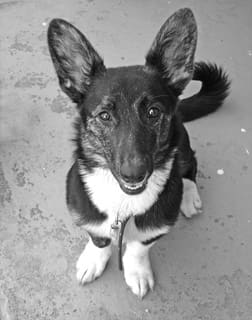
As is my custom on the day that I do assessments, I made a quick pass through the kennels before picking up paperwork for the day’s list of dogs. In one ward, a brindle-and-white pixie with huge stand-up ears, a low-rider body, and an excessively generous tail with one decisive curl in the middle captured my attention. A Corgi pup? I glanced at her kennel card. Sure enough – a five-month-old Corgi, and a Cardigan at that. (Pembrokes are the Corgis with short tails, Cardigans have long tails.)
I have long been enchanted by Corgis, and occasionally fancied adding one to the family some day. Perhaps this was the time?
Dashing back to the Operations Center, I placed the Corgi’s paperwork on the top of the stack. I was determined not to make too rash a decision – we would at least evaluate her before I lost my heart.
Develop a list of desired traits
In my case, I knew that I was looking for a small- to medium-sized dog, with a preference for a short-coated female. With three other dogs in our home already, a smaller dog would fit better than a larger one, and with one neutered male dog at home who could sometimes be aggressive with other male dogs, estrogen seemed like a wiser choice than testosterone. I lean toward the herding and working breeds; I like their genetically programmed work ethic. As much as I adore our most recent addition to our canine family (Dubhy, the Scottie), I really wanted a dog who was more hard-wired to work closely with people, and one who would (I hope) grow up to be highly social with people and other dogs. And I like to adopt dogs who are five to 10 months old – past the worst of the puppy stuff, but still young enough to be programmable. With that checklist in mind, the young Corgi seemed to fit the bill – so far.
The results of her assessment were mixed. On the positive side:
• She was highly social; she couldn’t get enough of humans – so much so that I was confident she’d be a good off-leash hiking partner on our farm.
• She was very bright and trainable; she quickly learned to offer sits during the training portion of the process.
• She was resilient and nonassertive, responded well to the startle test, and offered appeasement signals rather than aggression during the “stranger danger” test.
In the negative column:
• She did pretty persistent tail-chasing during the evaluation. Uh-oh … a dog with obsessive-compulsive behaviors at the tender age of five months. That’s a red flag!
• She never stopped moving. This little girl clearly is more energetic than the average dog.
• She was very vocal – and her voice was very shrill. Despite my intent to make an unemotional clear-headed decision, I was smitten. I carried her into Paul’s office and set her on the floor. He looked at her, glanced at my face, smiled, and said, “When are we doing the paperwork?”
We weren’t quite that foolhardy. We were confident that Tucker and Katie could manage to live with her, but knowing that Dubhy can be selective about his canine friends, we arranged to bring him in to meet her. If he gave the nod of approval, we would adopt. One week later, Lucy (short for “Footloose and Fancy Free”) joined the Miller family.
As we set about assimilating Lucy into our social group, I was humbled by the reminder of how challenging it really can be to adopt a young dog in sore need of good manners training. There’s nothing like having to use the suggestions and instructions yourself that you routinely offer your clients to give you a much better appreciation for how well they sometimes work – and sometimes don’t.
Modify to the individual
There are exceptions to every rule. No matter how well a technique may work with most dogs, there are some dogs who require their owners to stay flexible and be willing to tailor the technique to their needs.
Case in point: I frequently use tethering in my training center, and often offer it as a solution for dogs whose behaviors need to be under better management and control in the home. Such a simple, elegant solution – what could possibly go wrong? I was about to find out.
Lucy’s initial introduction to the rest of the pack was easy. We let them meet in the backyard, where the open space was more conducive to successful relationships. As we had expected, she offered appropriate appeasement behaviors to Katie “the Kelpie Queen” and was permitted to exist. She and Dubhy had already met and seemed to remember each other. She wriggled her way up to Tucker, the Cattle Dog-mix, and he accepted her annoying puppy presence easily.
Indoors, however, we discovered that at the tender age of five months she was already a dedicated cat-chaser. Perfect time for a tether, I thought – and quickly discovered that she still charged the cats when they entered the room, only to hit the end of the tether at full speed, moving a very heavy coffee table several feet, and risking injury to her neck. Tethered in my office, she promptly began guarding the entire space with ear-splitting barks and ugly faces.
She also gave shrill voice any time she was left tethered by herself in a room for even a brief moment. Leaving her a stuffed Kong or other valuable chew toy simply elicited serious resource-guarding behavior toward the other dogs. Too much tether time also triggered the obsessive/compulsive tail- chasing that worried me during her evaluation. Life quickly became very stressful. I experienced more than a few “What have I done?” moments.
Ultimately – as in four months later! – I finally succeeded in getting Lucy to lie by my chair rather than chase the cats. To accomplish this, I had to use less tethering and more counter-conditioning and desensitization (“Cats make really good treats happen!”). Our cats can again tread softly into the living room to spend the evening on our laps without fear of a Corgi attack.
Appreciate the successes
On the bright side, Lucy was everything I had hoped for in other areas. Our first day home, we went for a long hike with the rest of the pack. Halfway through, I took a deep breath, crossed my fingers, and unclipped her leash. As I had hoped, she stayed with the other dogs, and came flying back when I called her.
I smiled to see her bounding through hayfields, leaping after the butterflies that scattered in her path. She quickly learned to paddle in the pond and stick her head down groundhog holes with the other dogs. She will even happily traipse alongside my horse as we ride the trails – an even better source of exercise than hikes with the pack!
The daily exercise did wonders for her tail- chasing, which vanished in less than a week, returned when we had to restrict her activity following spay surgery, and vanished again as soon as she could run in the fields.
Feeding time was another challenge. Lucy’s propensity to resource-guard gave rise to a few dramatic meals, but the other dogs solved this one for me. Dubhy, a skilled resource-guarder in his own right, quickly set her straight about intruding on his dinner, and Lucy decided that she was best off with her nose in her own bowl. I knew that the commonly offered solution of feeding in crates wouldn’t work for her. She already guarded her crate space from the other dogs.
Adding food to the crate equation would have been a disaster!
Lucy came with some other behavior challenges. When taking treats, her hard mouth – “sharky” – actually drew blood from my fingers during our first few weeks together. This time, the advice I usually give worked, although it took longer than I expected, and it was even more difficult in the presence of the other dogs.
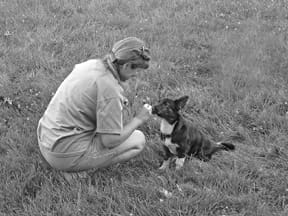
I began offering treats to her enclosed in my fist. If she bit hard enough to hurt, I said “Ouch!” and kept my fist closed until her mouth softened. When she was gentle, I opened my hand and fed her the treat. It was a delight to feel her begin to deliberately soften her bite, even in the presence of the other dogs or with a very high value reward. Now, five months later, I realize I haven’t “Ouched” for several weeks. Progress does happen!
Think outside the box
When a tried-and-true approach doesn’t work, don’t persist in hammering that square peg into a round hole. Instead, be creative and try to adapt your favored approach to your dog’s situation.
Lucy decided early on that she didn’t like going out the back door to the fenced yard. She quickly learned the back door means she’ll be out in the backyard for a while with the other dogs. She much prefers the side door, which means either hikes in the field, stall-cleaning time, or off to the training center – all of which she adores.
All my first responses to the problem only made it worse. The door is at the end of a narrow hallway, so calling her or walking down the hall and turning to face her, only made her less interested in going out. I tried continuing through the door onto the back deck myself, with no luck. Luring with treats worked twice; she got wise to that very quickly. Even though she is pack-oriented, she never fell for the trick of chasing the rest of the dogs enthusiastically out the door. Reaching for her collar to lead her out made her wary of my hands moving toward her.
We finally found two strategies that worked, and continue to use them both in hopes of getting her happy about going out the door rather than just tolerating it:
• Fetch! Lucy loves retrieving, so I have made it a point to frequently pair going out the back door with an energy-eating round of fetch the doggie disc.
• Leash! While Lucy quickly learned to avoid my reaching for her collar, she is happy to munch a treat from one hand while I slide a slip lead over her head with the other. Once leashed, she follows willingly out the back door and stands while I feed another treat and slip the leash off her head.
Patience pays off
I counsel owners not to adopt a second dog until the first is trained, because the difficulties encountered when trying to train two at once are more than most people can successfully take on. It’s challenging enough to train one dog – and it’s even harder to get much done if two or more dogs are out of control at the same time.
Although my other dogs are reasonably well trained, I made it a point to work with Lucy separately, at least at first, until she knew a new behavior, before I asked her to do it in the company of her canine companions. I had the luxury of a separate training center to work in, but even if I hadn’t, I could have worked with Lucy outside while the others were in, or vice versa. I could have trained Lucy in one room while the other dogs were shut in another part of the house, or crated them with yummy, food-stuffed Kongs so they didn’t feel deprived while I focused my attentions on the new kid. A dog can even learn to sit quietly in his own spot while watching another dog in training, knowing that the reward of his own turn is coming soon.
Lucy is nowhere near perfect. While she heels beautifully in the training center, she’ll still pull on leash outside unless she’s wearing a front-clip no-pull harness, preferably the K9 Freedom Harness (available from waynehightower.com). I found myself losing my patience with her pulling until I started using the harness. Now we both have more fun when she has to walk on a leash. We both prefer the off-leash hikes, of course.
She still jumps up, but not nearly as much as she did at first. Our persistence in ignoring the jumping up and rewarding polite greetings is paying off. She still has a shrill voice, but doesn’t use it quite as often as she used to. I must constantly remind myself – and Paul – to redirect her behavior when she’s barking, rather than falling into the natural trap of yelling at her to be quiet.

She now spends a lot of time lying quietly on my office floor instead of traumatizing kitties, hasn’t chased her tail in months, and chews only on toys provided for that purpose. She hasn’t had an accident in the house for several weeks now, and although she and Katie have small arguments almost daily, I don’t usually have to intervene.
Last night, as Paul and I sat watching TV, I looked up at all the dogs sleeping quietly on their beds, and realized that it’s been quite some time since I’ve had one of those “What have we done?!” moments. She has become a full-fledged member of the pack. She will never be Dusty, but she is Lucy, and that’s all she needs to be to stake her own claim to my heart. I hope your next adoption goes as well.
Also With This Article
“Adding a New Dog to a Multi-Dog Household – Plan Ahead!”
“New Dogs Do’s and Dont’s”
-Pat Miller, CPDT, is WDJ’s Training Editor. She is also author of The Power of Positive Dog Training, and Positive Perspectives: Love Your Dog, Train Your Dog.