

RAWHIDE CHEW SAFETY OVERVIEW
- Actively supervise your dog when he’s chewing a chew. To reduce the risk of choking or bowel obstructions, take it away from him if it starts shredding pieces that you wouldn’t want him to swallow whole, or when he gets close to the end.
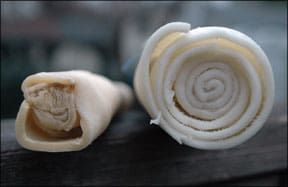
- Look for chews that are made from a single, thick sheet of rawhide.
- Don’t buy chews that smell putrid, or that have no odor at all.
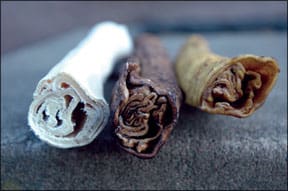
- Avoid rawhide products that are unnaturally white; extreme whiteness indicates extensive chemical treatment.
There are an infinite number of things in pet supply stores that are intended for our dogs’ chewing pleasure. I wouldn’t buy a great many of them for any dog of mine. Why? Because many are too hard, inviting broken teeth. Some are splintery, risking perforated intestines and other internal injuries.
I wouldn’t eat plastic for any number of reasons, and I don’t allow my dog to chew up and swallow bits of plastic-based chew toys, either. Animal-based chews seem more natural, but some (especially things like pigs’ ears) are dried to a level of brittleness that seems to invite internal injuries when the shards are crunched into small pieces and swallowed. It hurts my throat just thinking about it!
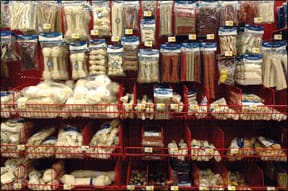
Chews made from dried tendons offer what I consider to be the ideal chewy consistency, but can’t be found in a large enough size to ensure that my large dog will be forced to chew them slowly, rather than swallow chunks that he could choke on. Dried “pizzles” (made from beef and other animal penises) also offer an ideal consistency, but I admit that I find them (and certain other chewy but identifiable anatomical parts, like pig snouts) too gross to handle.
That leaves me looking at the rawhide chews. Rawhide is made from dried animal skin, so it is stiff, but quickly softens under the influence of a dog’s saliva and the mechanical action of the dog’s jaws: no sharp shards! Purchased in the right form, it takes a lot of work for the dog to chew off little bits, so it presents a lower risk of choking or digestive problems than many other chews. It’s generally not smelly, messy, or overtly disgusting to touch or look upon, even though it’s an animal product. And because it’s an animal product, most dogs are immediately drawn to it and enjoy chewing it.
As attractive as rawhide is as a canine chew item, it’s not uniformly safe or wholesome. Rawhide comes in many forms, and not all of them are appropriate for your dog. Here’s how to identify the best rawhide chews. Please note that top-quality chews may not be available in every pet supply store you happen to visit; you may have to shop around or order online from reputable businesses to find reliably safe, good products.
What is Rawhide?
Most people are surprised to learn that rawhide is a by-product of the leather industry -not the beef industry. It might seem logical that, in a beef-producing and beef-eating country like the United States, we’d be practically rolling in rawhide for dogs; in fact, there is currently a glut of beef hides produced here. But U.S.-produced rawhide is in very short supply. How can this be?
As I said before rawhide is a by-product of the leather industry; its production starts in a tannery -and tanneries are rare in the United States today. One rawhide company representative I interviewed estimated that there are about 30 in the whole country; Mexico, in comparison, may have in excess of 3,000.
Tanneries use an enormous amount of water -and thereby create an enormous amount of waste water -to process beef hides. The cost of all that water, in addition to environmental laws, neighbor complaints, and the relatively higher cost of a relatively unpleasant business have all contributed to today’s shortage of tanneries in this country. According to Cattle Network, an information resource for the cattle industry, the U.S. exports more than $1 billion worth of hides annually to China alone; we are China’s largest source of hides from cattle, sheep, and pigs. Hides from American cattle fetch top dollar; the breeds of cattle here and our seasonally cool climate combine to produce a thick, consistent hide that, in turn, produces top-quality leather.
Cattle hides are shipped from slaughterhouses to tanneries for processing. Like any perishable meat product, the hides should be handled in a manner that prevents or minimizes decay. Hides that will be processed quickly, in this country, are generally iced and delivered to the tannery within no more than a few days. The vast majority of hides, however, go directly from the kill floor into a brine-filled trough; the highly concentrated salt solution arrests any protein-destroying organisms. The hides “cure” in the brine bath for about 12 to 18 hours before they are packed and shipped for export.
Of course, exportation takes time -and though the brining process helps slow decay, it can’t prevent it forever. Hides sent to China are typically trucked to ports on the West Coast, where they are packed into containers and loaded onto ships. It may take weeks or months for the hides to reach the tanneries in China and continue the process that turns them into chews for our dogs.
Once at the tannery, the hides are soaked, treated with lime (which helps strip the fat from the hide), de-haired (through physical and a chemical process), and then de-limed (accomplished by numerous water rinses). They are then treated with chemicals that help “puff” the hide, making it easier to split into layers. (“Full-grain” leather is made from unsplit hides.)
The outer layer of the hide is further processed into leather goods -car seats, clothing, and so on. The inner layer is the source of rawhide (and collagen, which is made into gelatin, cosmetics, and glue, among other things). Very thick hides may be split into three or more layers (hence the global popularity of thick American cattle hides).
Rawhide: The Inner Layer
Finally, we’ll talk about what happens at the rawhide dog chew manufacturing facility. In simple terms, the rawhide is washed; sanitized; formed, cut, rolled, and/or shredded and pressed into its final shapes; dried; packaged; and shipped for sale. But the actual simplicity of the process depends on freshness and quality of the rawhide.
Truly fresh hides -those that have been iced and refrigerated and delivered to the rawhide manufacturer within a few days of the source animal’s slaughter -require far less processing with chemicals than aged (and preserved) hides. “Sanitizing” in this case generally means some time in a bath of hydrogen peroxide. Exported hides require more extensive interventions.
Even though the brining process inhibits decay, it doesn’t arrest it altogether, and most exported rawhides are literally black with rot by the time they arrive at the rawhide processor. That means, at a minimum, they have to be bleached to improve their appearance and aroma; if the decay is advanced, they may also be treated with other chemicals and even painted with a coating of titanium oxide to make them appear white and pretty on the pet store shelves.
The global recession has slowed the demand for leather luxury goods; even the formerly strong market for leather for car seats has diminished as car sales have dropped to record lows worldwide. As a result, tanneries are buying fewer hides and producing less leather -which means they have less rawhide to sell to the makers of rawhide dog chews. It’s a bit ironic that these manufacturers are now scrambling to secure rawhide, even as containers of cattle hides have begun to accumulate all over the globe.
“Made in the USA”
The freshness factor alone is a good reason to try to buy American-made rawhide chews for your dog. But it’s also true that it’s less likely that illegal or toxic chemicals are used in the products’ manufacturing if the products are made in the United States. Lead, arsenic, mercury, chromium salts, formaldehyde, and other toxic chemicals have been detected in low-quality hides.
Read that label carefully, by the way. The pet product manufacturers are aware that many pet owners see “Made in China” or other indications of foreign manufacture as a red flag, and they are ingenious at finding ways to make their products look as if they were domestically produced. I’ve seen products with American flags on the label that were made overseas. Even the phrases like “made in America” or “made from American beef” are abused; sometimes, the fine print will reveal that what’s meant is Mexico, or South or Central America. There is a difference!
Some companies have made a case for the use of South American (especially Brazilian) beef hides. They say that cattle there are raised on grass, with fewer hormones, pesticides, and antibiotics, resulting in a healthier, more natural rawhide. Their competitors in the U.S. counter that cattle raised in warm, equatorial climates are thinner-skinned -resulting in thinner, less chewy chews -and that foreign manufacturing can be dicey. Both arguments have some merit, which is why I don’t use country of origin as my sole (or even the most important) selection criterion when shopping for dog chews.

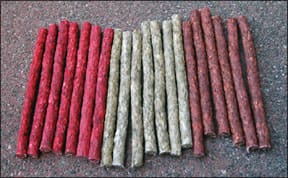
Instead, I look at the thickness of the hide itself (thicker is better, because it will take longer for a dog to chew) and its color. Extremely white hides are unnatural; they have to be bleached and/or painted to appear so white. Natural or lightly bleached rawhides are a light tan, like a manila folder. These less-processed hides retain more of the natural flavor and aroma of the hide. “Basted,” smoked, and decoratively tinted products might be any color (or odor) underneath the coating of (often artificial) dyes and flavors, and so I avoid them.
Speaking of odor: It stands to reason that the dried skin of an animal would naturally present some aroma. However, a rawhide chew really shouldn’t smell rotten or putrid; such an odor could indicate a high bacterial load. On the other hand, neither should a rawhide chew be completely odor-free! This would indicate that the product had been subject to extreme bleaching and chemical treatment.
More Selection Criteria: Form and Function
I admit that I have a strong bias about the form of the rawhide chews I buy for my dog, Otto. I want a chew that will take as much time as possible to chew up, provide a lot of exercise for his jaws, help clean his teeth, make it difficult to ingest a lot of rawhide in any one chewing session, and present the lowest possible risk of choking. These criteria eliminate very many of the rawhide products on the market, which seems silly to me; every rawhide chew should meet these requirements.
So, to start, I won’t buy any rawhide products that have small or intricate pieces. I examine “knotted” products carefully; the best ones are made from a single sheet of rolled and knotted rawhide, whereas inferior products are made with separate, smaller pieces of rawhide forming the knots on the end of a rawhide “roll.” After just a few minutes of chewing, the knots loosen and separate from the roll; these small pieces can be swallowed whole, presenting a serious choking hazard.
Neither do I buy products that are made of shredded and pressed-together tiny bits of rawhide. The makers of good-quality rawhide chews say they use natural (and beneficial) collagen as a binder for these products. But since ingredients panels are not required for these products -which, despite the fact that dogs ingest them, are not considered a food item by the Food & Drug Administration -there is no sure way to know what binding agent has been used as the product’s “glue.”
The rawhide products that seem to best fit my selection criteria are the “rolled” products, made from a square of rawhide that’s been rolled up like a newspaper and dried. As the owner of a big dog, I look for the longest rolls I can find, so they last as long as possible before they are chewed to a length that my dog could possibly swallow. Then I take them away. Owners of smaller dogs could probably start with shorter rolls, but what’s the point? The longer the roll, the longer it will last.
The first thing I look at when buying a rawhide roll is the end of the roll. That’s the only way to see whether it has been made from a single, long sheet of rawhide -or whether a smaller sheet has been wrapped around a lot of bits and fragments of rawhide. As with the knots that are separate from the roll on some knotted products, these bits will be quickly released from their rawhide sheath as the dog starts to chew. And what do dogs do with small chunks of edible matter? Most dogs swallow any chunk of rawhide they can chew free, whether it is soft and safe or sharp and dangerous.
Until recently, I would dig through every bin, and examine every package of rawhide rolls until I found some that appeared to be made from just a couple of large sheets of rawhide each. Then I discovered a company that makes each of its rolls from a single long, thick piece of rawhide. I’ve never seen rawhide rolls as nice as those made by Wholesome Hide.
Quality Rawhides are Worth the Expense
I’ve also never seen any other rawhide chews that are as expensive as these chews! Good quality rawhide rolls usually sell in stores for about $6-7 for a three-pack; a single roll of the largest size that Wholesome Hide sells for that much in some stores! (Prices are generally lower online and in bulk.)
However, the Wholesome Hide rolls last much longer than most rawhide chews; it takes Otto up to a week (chewing for an hour a day or so) to chew one down to the point that I take it away for safety reasons. As expensive as these rolls are, however, I’ve found that they are less expensive than leather work boots, redwood decking, and garden hoses! It behooves me to make sure that my dog has a variety of safe chew items available to him at all times, and rawhide has provided one of the most reliably time-consuming, trouble-free chews he enjoys. Don’t get me wrong; I wouldn’t want rawhide, no matter the quality, to be a staple of any dog’s daily diet. But using top-quality rawhide as one of his regular jaw-exercisers keeps him happily occupied.
Wholesome Hide makes its rawhide chews in Chicago, from beef cows raised here in the United States. They are sold in select pet supply stores around the country, and available from the below Internet retailer:
• Mickey’s Pet Supply
mickeyspetsupply.com; (877) 863-5431
There may be – there must be! – other companies…in the United States that make natural rawhide chews that meet all of our selection criteria. If you find products that meet this description, and that are not mentioned here, will you let us know?
Always Supervise Chew Time
Rawhide chews — of even the finest quality — may not be safe for every dog. Rawhide
(and most other chews) are not appropriate or safe for dogs who have an overly
aggressive chewing style, who tend to swallow large chunks instead of gnawing them smaller and smaller, and those who tend to “guard and gulp” their toys or chews to prevent anyone from taking them. Many vets have seen at least one dog with a big piece of rawhide stuck in its mouth or esophagus, or causing an upper airway obstruction or gastrointestinal distress.
We recommend buying oversized rawhide chews for every dog. The chew should be too big to fit entirely in the dog’s mouth. As soon as it’s been chewed to a size that the dog could swallow, it should be taken away.
Even dogs with a safe chewing style can experience stomach upset from ingesting rawhide. Some only have problems when they eat too much; others seem to react to chews of certain origin (indicating a response to the chemicals used in the manufacturing process, perhaps).
If your dog has experienced more than one problem from chewing or eating a QUALITY rawhide product, and you’ve already increased your supervision and the quality of the chews you buy, you should choose a non-rawhide chewing alternative. Rather than giving super-aggressive chewers harder things to destroy, we’d switch to non-destructible toys stuffed with food and things like the Lickimat, that engage the dog over time (but without chewing)
Nancy Kerns is editor of Whole Dog Journal.



Thank you for the article. I too am looking for an update/alternative to Wholesome Hide which is no longer available 🙁
Can you do an update for this story? Wholesome Hide is not available anywhere. I’ve loved Cowboy Chews on Amazon but now believe them to be bleached. I live on the West Coast of the U.S. and looking for something hard that will last my dog more than 20 minutes. Can’t find anything!
What do you think of the C.E.T chews as an alternative?
Excellent article!
I’ve found Barkoo raw hide chewables to be of excellent quality out here across the pond.
Farm Dog makes the best hide shews from local farmers with minimal processing. My dog doesn’t;t like them though because they are too hard to eat…they are only for chewing!!!
Pet Factory also makes a high quality rawhide, 100% made in the USA with American beef hide. Make sure you read the packaging, however, because they do offer products that are shipped to Mexico for processing for a more affordable option. Look for the “100% Made in USA” label, blue bag.
My little toy fox terrier has a sensitive stomach. I make her training treats with smooth reduced calorie peanut butter and mix with Gerbers dried and precooked oatmeal and banana baby cereal with probiotics. We have never found a chewing edible “rawhide” that she won’t throw up later. Puzzle and tendons are too jagged for her esophagus ( it’s tissue paper like as she weighs 5.4 lbs.) So there’s a new product called “mini Wonder Snaxx” that claim to be highly digestible PURE HIDE, the healthy rawhide. It’s made with peanut butter and apple flavor. It is a braided product the largest segment being soft flexible pure-hide peanut butter flavor ( the color of peanut butter) with two smaller braid pieces one of single strip of natural rawhide ( an ivory color) and the last braid part is a flatter green strip flavored with Apple (colored like a green Apple). Put out by HEALTHY CHEWS INC (dog club Great Taste award winner 2017) made in Mexico from American Beef Hide.
Ingredients: beef rawhide, peanut butter flavor, apple flavor, glycerin, liquid smoke, potassium sorbate, caramel color, vitamin C, vitamin E, FD&C yellow #6, FD&C yellow #5 49 cal. Per chew The package mentions ” minced American beefhide” for the caramel colored largest braid roll, where the other two are more striplike, and smaller. I plan on supervising my dog with it. She will be very protective to the point of aggressive if I want to take it away, but she’s been trained to give it to me if I offer ” we are trading” and give her a training treat in exchange for the rawhide. So if I need to take it away from her I can! I really appreciate a comment from you since you appear to respect your animals! Thank you so much! Patti T
Please don’t feed your dog anything with food coloring in it, which is only added to make the product appealing to people. Do you think your dog really cares what color the dog treats are?
Yellow 6 – Has been reported to cause allergies and is linked to hyperactivity in children. Some studies have shown that it has caused adrenal gland and kidney tumors in animals. It is also linked to skin issues, asthma, and chromosomal damage.
Yellow 5 – Also known as tartrazine or E102, this dye requires a warning label in Europe. It is commonly found in processed foods we humans consume as well as pet food, it is thought to cause neurochemical and behavior effects, including hyperactivity, aggression, and insomnia. It is also linked to asthma, allergies, thyroid tumors, lymphomas, ADHD, and chromosomal damage.