


ADOPTING DOGS TWO-AT-A-TIME: OVERVIEW
1. Think long and hard about getting two new puppies at the same time. Make sure you’ll be able to give both dogs everything they need.
2. If you do get two puppies, make a firm commitment to spend social time and training time with them separately, to avoid having them super-bond with each other.
3. Consider instead adopting one puppy now and another later, or better yet, one puppy now and an adult dog later.
There’s no denying it: a new puppy is one of the world’s most wonderful things. It’s a cold, hard heart that doesn’t get all mushy over puppy breath, soft pink puppy pads, and the fun of helping a baby dog discover his new world. So, if one new puppy is wonderful, two puppies must be twice as wonderful, right? Well, not usually.
Most training professionals strongly recommend against adopting two pups at the same time. The biggest challenge of adopting two new puppies is their tendency to bond very closely with each other, often to the exclusion of a meaningful relationship with their humans. They can become inseparable. Also, owners often underestimate the time commitment required to properly care for and train two puppies; as a result the pups often end up untrained and undersocialized.
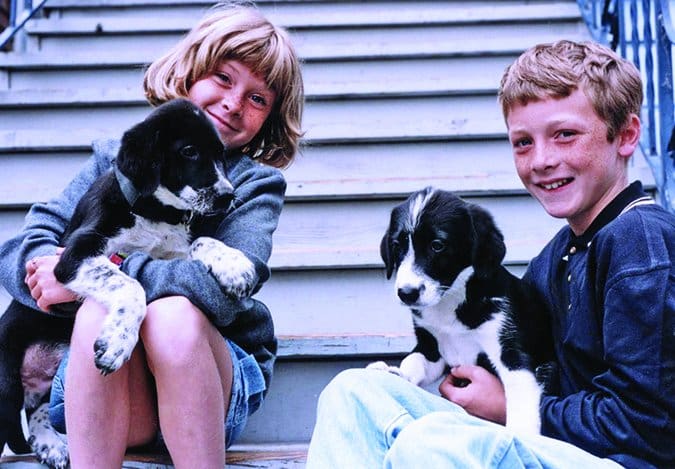
Don’t Get Two New Puppies at Once!
I’m the last person on earth to argue against getting a second dog, or even a third; my husband and I have five. However, there are very good reasons to think long and hard about not getting two new puppies at once, whether they are siblings or not.
While the majority of new puppy owners seem to recognize that one puppy is enough of a responsibility for them, a certain number fall prey to one of a few common arguments about why two puppies might be better than one. I can rebut every one of them!
Let’s take a look at the most common reasons that people say they want to adopt two puppies at the same time – and why they shouldn’t be considered.
Two-pup rationale #1: “I want to get two puppies so they will have someone to play with while I’m gone all day at work.”
It’s a good thing to recognize that your pup could use companionship during the day. However, if you think one puppy can get into trouble when you’re not there, just think what kinds of mischief two pups can cook up when left to their own devices. Better solutions might include:
• Adopt your new pup at a time when someone in your family can take a week (or several) off work to stay home and help the puppy adjust gradually to being left alone. A couple of weeks vacation time? Kids home for the summer? Just be sure to use the time wisely, so your pup can learn to happily accept being alone when it’s time to go back to work or school.
• Find a friend, neighbor, or relative who is home much of the time and who is willing to provide daycare for your pup – and experience the joys of having a puppy to play with during the day, without the long-term responsibilities and costs of having a dog for 15-plus years.
• Ask your vet if she has another client with a similar-age puppy, and see if the two of you can mingle your pups at one of your puppy-proofed homes for puppy daycare, and send the second baby dog back home after work. Note the emphasis on “puppy-proofed.” Two pups can still get into a heap of trouble, even if one of them isn’t yours.
Two-pup rationale #2: “I have two children and they each want their own puppy.”
What a sweet idea. Just say no. Since when do the kids get to make the rules? Seriously, most families I know have enough trouble getting their kids to fulfill their promise to feed, walk, and clean up after one family dog. Mom ends up doing most of it anyway. So now Mom gets to do double-puppy-duty? If there’s a compelling reason for them each to have a dog, consider adopting one puppy now, and an adult dog from a shelter or rescue group. Even then, I’d adopt one first and give her at least a month to settle in, if not longer, before adopting the second.
If you must adopt two puppies at the same time for the kids, see the second half of this article.
Two-pup rationale #3: “We want to have two dogs eventually anyway, so we might as well get them at the same time so they can grow up together as best friends.”
Well, that’s what you might well get! When you raise two puppies together they usually do grow up to be inseparable best friends, often to the detriment of the dog-human relationship. Inevitably they spend far more time together than they do individually with you, with a likely result that they become very tightly bonded to each other and you are only secondary in their lives. Many owners of adopted-at-the-same-time puppies ultimately find themselves disappointed in their relationships with their dogs, even when they are committed to keeping them for life.
This super-bonding also causes tremendous stress (and stress-related behavior problems) on those occasions when the dogs do have to be separated – and sooner or later, something will come up that requires them to be separated: one goes to training class and the other doesn’t, you want to walk one but not both, or a health-related problem requires one to be hospitalized or otherwise kept separate.

Two-pup rationale #4: “A second puppy will play with the first and keep her occupied when I’m too busy to spend time with her.”
Nice thought, but here’s a heads-up. If you’re too busy to give one puppy the time she needs, you’re definitely too busy for two puppies!
There are great interactive dog toys on the market that can help occupy your pup when you can’t play with her – and don’t think that either another puppy or a pen full of toys can substitute for social time with you. Puppies do take time, and it’s important you give that some serious thought before adding a baby dog to the family. It’s fine to give her playmate-time via arranged play dates with a friend’s healthy and compatible puppy, but don’t think adopting a second pup is an acceptable substitute for your own interaction with your puppy.
Two-pup rationale #5: “If we adopt a second puppy, that’s one fewer that might be euthanized.”
I won’t argue with this, except to say that in many shelters around the country today, puppies aren’t the problem. Of course there are exceptions, but I’d say the majority of shelters in the United States now have no problems placing most if not all the puppies they get. It’s the adult dogs who are most likely to die because of homelessness. If you really want to save a life, adopt a grown-up dog instead of a puppy, or at least adopt your puppy now, and come back for an adult dog in a few months.
Two-pup rationale #6: “The breeder we are buying our puppy from thinks it’s best if we take two.”
If you’re buying from a breeder who encourages you to purchase two puppies at once, run away fast. A truly responsible breeder will, in most cases, refuse to sell two puppies to one home, except on the rare occasion that a prospective buyer can prove she has the skill, knowledge, time, ability, and monetary resources to provide an excellent environment for two pups at once. Someone who tries to push two puppies on a buyer isn’t a very responsible breeder, and isn’t doing her puppies, or the new owner, any favors.
What to Do If You Adopt Two New Puppies
Perhaps you’ve already adopted two new puppies and are ruefully regretting your error. Or maybe you don’t regret it, but you realize you’ve taken on far more of a responsibility than you realized. Perhaps you’re determined to go ahead and do it anyway, despite my advice above. If you do take the bait and find yourself in double trouble, there are things you can do to minimize problems and maximize your success as the owner of a puppy pair:
1. Crate them separately. Your pups are going to have plenty of together time; they don’t need to sleep together too. You can certainly leave them together in their puppy-proofed space when you’re gone all day, but they should be crated separately at night. You can crate them near each other, but this is the perfect time to start habituating them to not always being in close contact with their sibling. (See “Crating Woes,” Whole Dog Journal May 2005.) When they are comfortable in their crates close to each other, you can gradually increase distance between crates until they can be crated out of sight of each other, perhaps even in another room.
You can also do the “separate crating” thing cold turkey. If your children are old enough to be responsible for taking their pups out in the middle of the night, start from day one with a pup crated in each kid’s room.
In any case, the puppies’ separate crates should be in someone’s bedroom. This is vitally important so someone hears them when they wake at night and have to go out. The pups also benefit from the eight hours of close contact with you, even though you’re all sleeping. And by the way, you can bet if one puppy wakes up to go out, the other puppy in her nearby crate will wake up, too.
2. Train them separately. Your training programs will be much more successful if you take the time to work with your pups individually. If you are using clicker training (and I hope you are!), you’ll probably find that it’s confusing and difficult to try to click and reward one pup for doing a desired behavior when the other pup is doing an unwanted behavior. When this happens, both pups think they got clicked, which means you’re reinforcing the unwanted behavior as well as the desired one. Oops! Not to mention that it’s much more difficult to get and keep any semblance of attention from either puppy if the other is present as a distraction.
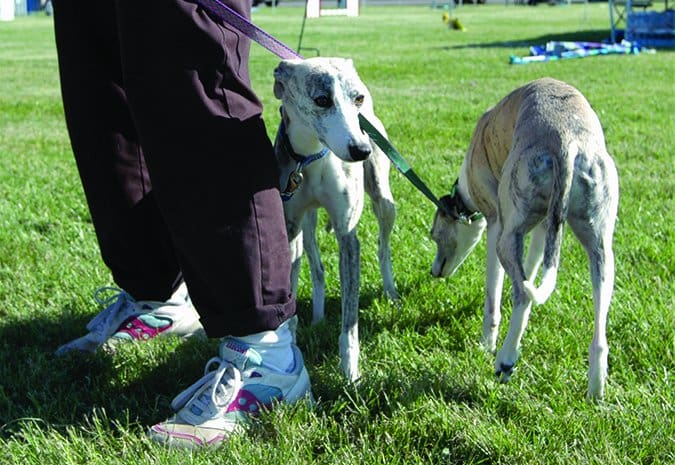
Training time is a perfect opportunity to give your pups a positive association with being separated. One gets to play (train) with you and get attention, clicks, and yummy treats, while the other gets to hang out in her crate in another room, preferably far enough away she can’t hear you clicking, and empty her deliciously stuffed Kong.
If there’s a second trainer in your family, that person can work with the second pup in another room at the same time. Eventually you can each work with them at the same time in the same room, and sometime in the future one person can have fun working with them both at the same time. But that’s down the road somewhere, after they’ve both learned their good manners lessons very well.
3. Play with them separately. It’s common in puppy pairs for one pup to be more assertive than the other, and take the lead in puppy activities. It’s fine to play with them together some of the time, and it’s also important to play with them separately, so the more assertive pup doesn’t always get to make the rules for the other.
For example, if you always play “fetch” with the two together, you’re likely to see that one pup repeatedly gets the toy and brings it back, while the other runs happily along behind. If you watch closely, you may even see the more assertive one do a little body language warning if the other tries to get the toy – a hard stare and stiffened body, perhaps. The less assertive one defers to her sibling by letting go of the toy and looking away. That’s a fine and normal puppy interaction, but it can suppress the “softer” pup’s retrieving behavior. Unless you make the effort to give her positive reinforcement for fetching toys when you play with her alone, you might find it difficult to get her to retrieve later on in her training.
4. Walk and socialize them separately. Just as with your training sessions, you’ll need to walk one pup while leaving the other behind with something wonderful, or while someone else walks the other one in the opposite direction around the block. Walking them together with different handlers doesn’t work; the less confident pup will come to rely on the presence of the more confident one to be brave in the real world. Then, when the more confident one isn’t there, the shyer pup is more likely to be fearful. All the activities you would normally do with one pup, you need to do with each pup individually.
Signing up for puppy training class? Set aside two nights, not one, and take them to separate classes. Going to the groomer? It’s two trips, not one. Time for that next set of puppy shots? Make two appointments, not one. Oh okay, I’ll give you a break – it doesn’t have to be every time, but they should go somewhere by themselves at least as often as they go together.
So, are you getting the idea of the “separate but equal” program? Everything you would do with one puppy you need to do with each puppy separately. This is to be sure they’re both getting the attention, training, and socialization experiences they need, without the interference of the other pup, and so they’re not dependent on the presence of other pup. Of course you can also do things with them together, but you must be sure they are completely relaxed and comfortable about being apart.
For super-bonded dogs, separation becomes a world-class crisis, fraught with life-threatening behaviors such as anorexia (refusal to eat in the other’s absence), separation anxiety (barking, destructive behavior, relentless pacing, and howling), and other stress-related behaviors, including aggression.
Inevitably, at some time in their lives super-bonded dogs will have to be separated. One will get sick, or need surgery, when the other doesn’t. Most of the time, one will die before the other. I know of cases where the surviving dog of a super-bonded pair has had to be euthanized after the partner died, as he was too stressed by himself to be able to function. This is not a situation any loving dog owner wants to face.
Other Factors Involved in Adopting Two Puppies
Behavioral considerations are the reason that most trainers recommend against adopting two puppies at once. But there are other reasons that have nothing to do with the dogs’ behavior.
1. Cost. Not surprisingly, it costs twice as much for routine feeding and care for two puppies as it does for one. But don’t forget the catastrophic care costs! If one pup contracts a deadly disease such as parvovirus, you’re on your way to the emergency clinic with two pups, not one. Sure, if one gets injured the other’s not likely to have sympathy injuries, but with two pups the chances of one getting injured in some manner double.
2. Clean up. Let’s not forget puppy pee and poo. One pup produces more than enough waste for any sane human to deal with, and with two pups you naturally double the production.
If that isn’t enough, consider this: You leave your pups in an exercise pen when you’re not home. One pup is likely to learn to eliminate in a corner of the pen reasonably quickly, and will hopefully avoid tromping through it. Two puppies may select two different corners of the pen as designated bathroom spots, which doubles the chances of poop tromping. On top of that, if the two pups get to wrestling, as pups do, there’s a much greater likelihood of them rolling around in poo than there is if one pup is playing by herself.
Picture yourself coming home from a long, hard day at work, tired, looking forward to a little loving puppy cuddling, to find a pair of poo-covered pups in a pen plastered with the stuff from one side to the other. I’m just sayin’. . .
3. Housetraining. Of course, when you’re home, the puppies come out of the pen to be with you. We normally recommend the umbilical cord approach to housetraining: at first keeping your pup on a leash or tether, or with you, under your eagle eye, all the time, and going out to the designated potty spot every hour on the hour.
Now you’re tied to two puppies who want to wrestle with each other under your feet – or one’s tied to you and one to another family member. As the pups mature you lengthen the time between potty breaks and start relaxing supervision, when the pups demonstrate their ability to “hold it.”
Oops! There’s a puddle. Which pup did it? Oh look, there’s a wee puppy pile of poo under the dining room table. Oh no! I see teeth marks on the corner of the antique loveseat! If you have one puppy and you’re having a persistent problem, you clearly know who needs more supervision, or a quick trip to the vet to rule out a possible medical issue. With two pups, you have to increase management and supervision on both of them, and may never know for sure which one is having accidents. Or maybe it’s both!
4. Gender. Some people say if you’re going to have two puppies, get a boy and a girl. Others say get two boys. Some might specifically warn against getting two girls, stating that two female adult dogs in the same family will fight. Others will tell you they’ve had two girl dogs at the same time, no problem.
Here’s my take: Plenty of same-sex puppy pairs get along just fine throughout their lives. Plenty of mixed-sex pairs do the same. There are same sex pairs that end up with conflicts, and there are mixed-sex pairs that end up fighting with each other (despite super-bonding). It does seem to be true (and there are some studies that indicate) that intra-pack conflicts involving two females tend to be more intense than intra-pack issues between two males, or opposite sex pairs. That doesn’t mean there will be conflict if you adopt two girl puppies, only that if there is, it may be more difficult to resolve than differences of opinions between two boys, or a boy and a girl.
Think About It
Is the extra fun of having two puppies at one time worth all the extra time, energy, cost, and headaches? I’m warning you not to do it. I’m recommending you adopt one now, and another in six months to a year, when the first has bonded with you, and at least completed her basic good manners training.
But if you decide to do it anyway, and are ready to do all it takes to make it work, then you have my sincere blessings and best wishes. But please, be honest and realistic about whether you and your other human family members really have the resources and commitment to give both pups what they need to ensure their lifelong loving home with you. Go find your two wonderful puppies and have an absolutely great life with them.




This is a great article with sound advice.
We definately fell into the category of wanting two forever dogs, so why not get them at the same time.
We had always had multiple dogs and didn’t even consider that they wouldn’t fall under our spell, as all our other dogs had done, and quickly.
We were quite prepared for all the extra time and commitment they would require, and toilet training seemed to take a good 6 months, even though we would take them outside 3 or 4 times a night, whenever they stirred.
The first 12 months were just hard. They were very destructive, ruined furniture, carpets (by chewing it) even chewed holes in our walls. They were not left to their own devices as my husband was home with them all day every day, but this still happened. The problem was that they were so bonded to each other and took their cues from each other and didn’t take any notice of our attempts at discipline and training. We had training, dog obedience and then specialised training to try to understand the problems and rectify bad behaviours.
Fast forward and they are now 2.5 years old. Through the passage of time and maturity they are now very bonded and responsive to us. They seem very social with other dogs and people and we are more than happy with how they have turned out.
They can be seperated for a few hours with no distress, but they do read each others minds and the only real issue we have is that when we are at our local park, when they get hot, they will suddenly look at each other and say ‘lets go!’ and they will take off. We have absolutely no recall over them (they have great recall any other time) and they go for a great cool off.
This is their only failing. We have all come a very long way, but the first year was costly, frustrating and far from what we had envisaged.
I would do it all again but knowing what I know now, I’d do exactly what this article advises. We did the opposite. They were always together and that made it harder and more challenging than it needed to be.
I have recently adopted 2 chis , a brother and a sister when 8 weeks old. They are now 5 months old. I have to say that I have been spendig incredible amount of time with housebreaking, obedience training and socialising them. It is my first time I have been raising the puppies and though I tried reading as much, I made some mistakes however, i can conclude the following:
1. crate them separately ( this helps w managing hyper energy pent up, witching hour, etc)
2. teach them where to potty immediately
3. Teach them obedience
4. Teach them fetch or any other play
5. Socialise them early w ppl, dogs, streets, etc.
6. Give them love, tenderness and care
7. Leave them alone for some time ( separatoon anxiety)
8. Do not allow them into bed until fully obedient ( establish rules)
9. Learn tricks how to teach them good manners ( not biting, nipping, barking, etc.)
10. Have fun& lots of patience!
It took me 3 months of hard work but I can say that my puppies are well bonded with one another, as well as with me, other people and doggos in the park. It is all about time and devotion to training them.
Good luck!
I am in the Masonry Business and I agree with all your safety tips. You actually reminded me to have a refresher with my staff about safety precautions. Thank you and looking forward for more post from you.
We bought a 8 week old German Shepard Pup. When returning to the breeder for his 10 in 1 shot she had said that one of his litter mates had been returned because of a heart murmur. Most puppies outgrow this – but the person wanted their money back and wanted to return the dog (not sure how this happens as we instantly loved our pup). Anyway of course she can’t sell him in this condition and she mostly trains dogs, so her concern was giving him love and attention. With that being said – we are living the 2 pup life now. We didn’t intend to do this but our hearts are big and we wanted to give the new little guy the love and attention he deserves. So with that being said I found the article helpful. I don’t feel like I was crazy or stupid getting two littermates – but I see the difficulties in this now. I do feel that they could bond more with each other and I do see that challenges and will strive to remedy this by the suggestions offered in this article. Before reading this we had already decided that my daughter who has two adult rescued dogs is taking the one pup who is aggressive and won’t leave the other one alone home with her for a while to give them space for separation and training time. But I do see the need to make sure they both have that one on one time with us separately – but not extreme.
We just brought home two male mini AussieDoodles at 8 weeks and they have very aggressive play time right now. We crate separately for sleeping and only bring them together a few times a day to play. How do you recommend breaking the aggressive play?
Just want to put my experience out there…
We got 2 female litter mate Yorkshire terriers.
They have been the best dogs we’ve ever had.
They bonded with both my husband and I and with each other. They trained quickly and have never fought over food or anything else.
They are now 11 years old and despair of when we will lose them, but would do it again in a heartbeat.
I’ve currently got one female cavoodle and plan on getting a 2nd one (a male) from another breeder so they are not siblings. The difference in age is 5 and a half weeks. Do you think they will still have the problems as listed above? the female one we have currently is nearly 4 months old so both are puppies. Do you they still need to be crated separately or does this apply to certain breeds.
We just got an 8 week old female corgi and have been planning this whole time to get a female pug of the same age to grow up with her. The pug will not be ready for another 3 weeks. Reading this article makes me second guess our decision. Right now we are crate training our corgi and she wakes up 3 times a night to pee or poop. I am not sure what to do from here, because the pug we are getting is one I have wanted for so long- there is no guarantee that there will be another like her in a year. I’m easily persuaded by articles such as this one, now I’m just bummed and torn! Has anyone out there had a pug and corgi puppies together? Did you have any issues?
We have a 6month old shiba inu puppy (male) and found out that we could adopt a 4 month old puppy (also male).
They bought the pyppy a week ago, but their kid is very allergic…
Now I don’t know what to do… Would love to give the puppy a forever home, but affraid that it will not go with our other puppy. The one we have now reacts very playfull to other dogs, is not agressive, …
Excellent items from you, man. I’ve have in mind your stuff
previous to and you are simply extremely magnificent.
I actually like what you have got here, certainly like what you are
stating and the way in which in which you assert it. You make it enjoyable and
you still care for to keep it smart. I cant wait to learn far more from you.
That is actually a great website.