

I’m not one of those dog owners who has her dogs wrapped in cotton wool, constantly looking to protect them from any and all possible hazards. I walk my dogs off-leash in rattlesnake habitats. I sometimes feed them raw eggs. I allow them to swim without wearing life jackets, and so on.
Some of my willingness to expose them to potential health risks might be due to my generation. As the youngest of four kids raised in the 1960s, I grew up unseatbelted – in fact, most of the time I sat on the hump between the two front seats! My generation was subjected to many more potentially life-endng risks than are even legal today.
But there are a couple specific risks I absolutely will not take with my dogs, and they have to do with their collars.
STANDARD TANG BUCKLE
The first danger I won’t expose my dogs to is a collar with a regular metal buckle – you know! The kind that has a frame and a tang or prong that fits through a hole on the collar and is secured by the back of the buckle frame. Why have I taken a stand against such a ubiquitous piece of dog equipment?
The answer is: Because in a terrible emergency, when a dog’s collar is caught on something and he’s choking to death, the only way to unbuckle that buckle – to get that metal prong or tang out of its hole – is to pull it a little bit tighter. And you will have to believe me when I say I know, from personal experience, that when a dog starts choking to death, he won’t be holding cooperatively still in perfect understanding that you need to make his discomfort worse for a moment in order to save his life.
The dog who nearly choked to death in my hands was not my dog – he belonged to a neighbor. But I ran to help when I heard the sound of dogs and women screaming, and was confronted with a writhing tangle of gasping, screaming, urinating, panicking canines. Two dogs had been playing when one grabbed the other by his collar and then rolled over; the collar twisted, pressing his tongue into his own lower teeth – and tightening to the point of choking his playmate.
I and the dogs’ owners, both young women, tried frantically to figure out how to untwist the dogs, but they were big, strong dogs in a full panic, and we couldn’t do it. I dug my hands into the dogs’ fur, looking for buckles to unbuckle. One dog was wearing a quick-release collar – but it wasn’t the collar that was tight. I finally found the buckle for that collar, and it was partially in the mouth of the dog who was twisted, impossibly tight – too tight to be able to tighten it more in order to get the tang of the buckle undone.
As I was working to find the buckles, one of the other women ran into the house and got scissors. She managed to hack through the thick nylon collar, releasing the dogs just a moment after the choking one lost consciousness and released his bowels. About two seconds after the collar was cut, he took a gasping, ragged breath, and then another, and slowly came to as we sobbed and patted him and the other dog and hugged each other.
PLAY NAKED
There is a second lesson to be learned from my nightmare story: When dog friends are playing bitey-face games, they shouldn’t be wearing collars at all. Playful dogs who are left home alone together shouldn’t be wearing collars, either.
TAG, YOU’RE IT
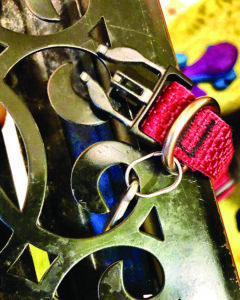
Here’s the other thing I don’t like to see hanging from dogs’ necks: Metal or other rigid ID tags – because it’s easy for tags to get caught on things, pinning a dog in a scary position and causing her to panic.
The last time I used tags was on a foster dog I had crated in my kitchen. I heard a ruckus and found her thrashing; her tags had somehow slipped through the ventilating slits on the side of the crate (perhaps when she was turning around?) and got stuck.
More commonly, dogs get stuck when they lay on a floor near a floor-mounted vent, either warming or cooling themselves, as appropriate for the season. Their tags slip through the vent as they lay on the floor, and when they try to get up, the tags turn and get stuck. Hysteria generally ensues. Best case, someone is home and rescues them. Worst case? Don’t ask. Awful.
SOLUTIONS
Personally, I am comfortable having my dogs collar-free most of the time. If they escaped my home, say, in an earthquake or something, I know that they would readily go to my neighbors or even strangers for rescue. They are microchipped and the chips are registered to me with current contact information.
But if keeping ID on your dog is more critical to you, perhaps because your dog might be a major flight risk if she got loose, there are a few safer solutions.
As an alternative to using ID tags, I buy collars that have side-release plastic buckles (easy to unsnap in an emergency) and have my phone number stitched into the fabric. However, even these are taken off when I am not home or when I am fostering a dog who might play with my younger dog (my older dog doesn’t play).
Silicone tags, such as the ones from Silidog.com, are a safe alternative. They are strong but flexible; even a spindly, tiny dog would be able to pull free if his silicone tag got caught.
I am aware of one collar that closes with a patented break-away buckle, which can tear apart if a dog gets caught by the collar. It’s called the KeepSafe Break-Away Safety collar, and is available from breakawaycollar.com.
Please consider employing at least one of these alternatives if you currently use a standard buckle collar and/or metal tags on your dog.
Nancy Kerns is WDJ’s editor.




I will ONLY use a collar with a good metal buckle.
These silly plastic quick release thingies break a the slightest pressure – -and you have your dog off lead in a dangerous situation. You also have a dog with NO ID except their microchip — which few people in the in rescue organisations seem to bother to check!
I use broad and thick real leather collars and can support the dogs weight with it hanging on the collar, You can save their lives this way. Pull them out of swamps. Stop them freaking out and running through heave traffic,
Just NEVER ever use a cord or narrow collar — and never any form of slip collar.
As someone involved for many years in greyhound rescue, I always warn foster folks and adopters to not leave martingale collars on their dogs for the same reasons but it remains common to see greys wearing martingales (with tags!) in lieu of buckle collars.
I really appreciated the article and all the comments! I found out myself that leaving a collar and tag on can be very dangerous.
I have a slatted bench, and my dog got her dog tag stuck between the slats. Thankfully I was sitting next to her and could free her immediately. She could have been strangled if she had fallen off.
Another time, when my young dog walker brought her back home, she got away from him with her leash and collar on and he left. Unfortunately, I was gone for 3 more hours. She had been trapped by her leash getting stuck in the space between the boards on the back deck. She was so scared when I got home, and she was hoarse from barking. It has been months since and she still sounds a little hoarse. I had immediately called the dog walker and told him to do whatever you he has to do to get her back, but get the leash off of her before leaving!
Nancy, Thank you for this blog. I have left collars on my dogs forever even though I knew the risks. I have been lucky. I just ordered collars and ids for my two dogs so I will be able to breathe easier.
I love your posts. I’ve never been disappointed with anything you have written. Keep going; I need you.
Thank you so much for republishing your original article once a year!! There are so many ways dogs can get their jaws or collars caught on something and have the worst possible outcome. A woman at work told me about leaving a prong collar (!!!) on her bulldog when she and her husband were at work. There was one of those metal racks by the back door that has metal shelves made with thin but very strong metal wires (about the thickness of fat spaghetti) laid end to end. The dog could see out the window in the back door right next to it and jumped up and down when it saw a squirrel. You can guess the rest. I cried for the rest of the day at work, but it cured me of leaving collars of any kind on my dogs when we weren’t home. My Corgi is microchipped and I use a harness with small Xerox copies of all tags that fit into a little pocket on the back of the harness, and I carry his actual collar with the metal tags in a pouch on me with treats, poop bags, etc. in case anyone in authority demands to see the originals. I like the idea of the hanging silicone tags, and one answer (besides the quick (please God) release snap collar – might be to hang them from plastic loops on the collar that would snap easily with very little pressure. It would mean ordering a big batch at a time due to attrition, but not too much money spent when you think of what you spend on vet bills over the life of the dog. One thing I have noticed repeatedly is that when a lost dog wanders into my neighborhood, whether they are wearing an obvious collar or not, is that they are scared and standoffish and will bark and not come anywhere close to someone trying to help them. I’ve spent nights sitting out in the dark on a chair with everything from raw liver to cheese in my hand without moving a they would circle me but never get close enough. The dogs look mostly well-groomed and cared for, but I have to wonder about their socialization as a puppy or bad treatment later on at home. Most all of them I couldn’t get near and never found out what happened.
when my GSD started yanking the vents out of the floor with her rabies tag and then prancing around the house while they where hanging around her neck, that is when we stopped allowing the dogs to wear their collars in the house.
What about if our dogs are used ton wearing only a harness with the necessary ID tags resting on their backs?
Harnesses are much less likely to choke a dog who is wearing one — but they do offer more opportunities for the dog who is NOT wearing the harness to get caught/trapped in the harness.
Seriously, nothing is perfect. It’s all a matter of avoiding the most dangerous scenarios and keeping a sharp eye on our dogs when they are playing with others.
thank you.
A year ago I bought two break-away collars for my ruff-house pups; the collars were less than $20 each. We have an acre of fenced yard & canine visitors (& their humans) come to play. Tremendous sense of relief with this safety feature collar.
I lived that same, exact, terrifying story with a quick-release collar. The release was under one dog’s tongue. It was only when the other one lost consciousness that we were able to pick up the conscious dog and rotate her to release the other dog. We managed to resuscitate her, and immediately got her to the vet, but she still sustained some brain damage.