

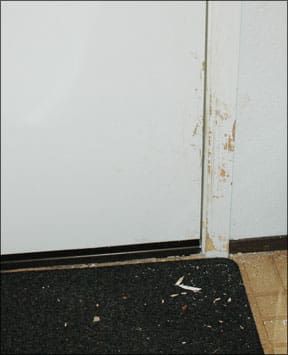
Have you ever had the misfortune of walking into your house to find overturned furniture, inches-deep claw gouges on door frames, blood-stained tooth marks on window sills, and countless messages on your answering machine from neighbors complaining about your dog barking and howling for hours on end in your absence? If so, you’re probably familiar with separation anxiety in dogs – a mild label for a devastating and destructive behavior.
Thirty years ago the phrase was uncommon in dog training circles. Today it’s a rare dog owner who hasn’t heard of separation anxiety in dogs, experienced it with a one of her own dogs, or at least had a friend whose canine companion reportedly suffered from this difficult disorder. Separation-related behaviors seem more common these days, and sadly, can also result in human frustration and anger – and sometimes even the euthanasia of an offending dog when a despairing owner reaches her wits’ end.
In her excellent book, Clinical Behavioral Medicine for Small Animals, Dr. Karen Overall defines separation anxiety as, “A condition in which animals exhibit symptoms of anxiety or excessive distress when they are left alone.” The most common separation anxiety symptoms in dogs include destructive behavior, house soiling, and excessive vocalization. Many dogs with this challenging behavior also refuse to eat or drink when left alone, don’t tolerate crating, pant and salivate excessively when distressed, and go to great lengths to try to escape from confinement, with apparent total disregard for injury to themselves or damage to their surroundings.
It’s natural for young mammals to experience anxiety when separated from their mothers and siblings; it’s an adaptive survival mechanism. A pup who gets separated from his family cries in distress, enabling Mom to easily find him and rescue him. In the wild, even an adult canine who is left alone is more likely to die – either from starvation, since he has no pack to hunt with, or from attack, since he has no pack mates for mutual protection. For this reason, signs of separation anxiety in puppies is somewhat expected.
Given the importance of a dog’s canine companions, it speaks volumes about the dog’s adaptability as a species that we can condition them to accept being left alone at all! We’re lucky we don’t have far more problems than we do, especially in today’s world, where few households have someone at home regularly during the day to keep the dog company.
There was a time in our society when fewer dogs were left home alone – Mom stayed home while Dad went off to work every day – so dogs had less exposure to the kind of daily isolation that contributes to separation anxiety behavior. Some behavior scientists theorize that experiencing a fear-causing event when a young dog is already mildly stressed about being alone can trigger more intense “home alone” anxiety behaviors.

In today’s world there are a significant number of dogs who are afflicted with some degree of separation distress. The best solution for how to break a dog’s separation anxiety depends largely upon the dog’s situation and anxiety triggers. Fortunately, many dog owners these days are willing to seek solutions to behavior problems rather than just “getting rid of” the dog. As a result, behavior professionals are likely to see canine clients with separation distress disorders.
Symptoms of Separation Anxiety in Dogs
Another reason separation anxiety seems more prevalent today than a few decades ago is that it is misdiagnosed with some frequency by laypersons. With an increased awareness of the condition has come an increase in misidentification of behaviors that resemble separation distress behaviors, but really aren’t.
For example, house soiling can be related to anxiety, but there are many other potential causes. These include incomplete housetraining, lack of access to appropriate elimination areas, unreasonable owner expectations (expecting the dog to “hold it” for 10 hours or more), fear, excitement, marking, submissive elimination, or physical incontinence.
Destructive behavior may be a result of separation anxiety, or it could be normal puppy behavior, play, reaction to outside stimuli, and/or an outlet for excess energy. Separation distress could be the cause of excessive barking and howling, or the dog could be stimulated to bark by street sounds (traffic, people talking), trespassers (i.e., a mail carrier, intruder, Girls Scouts selling cookies), social facilitation (other dogs barking), play, aggression, or fear.
It’s critically important that a problem behavior be correctly identified prior to the implementation of a behavior modification program. It does no good to try to modify separation anxiety if that’s not really the problem.
If a dog pees in the house when left alone as well as when the owner is home, it’s more likely a housetraining problem than a separation issue. However, a dog urinating in his crate when the owner leaves the house, but who is fine holding it through the night, is an example of possible separation anxiety. Separation-related destruction is usually directed toward escape efforts – chewing or clawing at or through doorframes, windowsills, and walls. If the destruction is more generalized throughout the house, it points toward one or more of the other possible causes, rather than an isolation issue. A strategically located video camera or sound-activated tape recorder can help identify possible outside stimuli, such as visitors to the home or unusual noises, that might trigger what otherwise may appear to be separation-related behaviors.
Isolation Distress and Separation Anxiety: What’s the Difference?
Distress over being left alone is not always a full-blown separation anxiety problem. First, a dog may suffer from a mild distress to a severe anxiety disorder. “Distress” indicates a lower intensity of stress behaviors when the dog is alone, while “anxiety” is an extreme panic attack.
The distinction between “isolation” and “separation” is equally important. Isolation distress means the dog doesn’t want to be left alone – any ol’ human will do for company, and sometimes even another dog will fill the bill. True separation distress or anxiety means the dog is hyper-bonded to one specific person, and continues to show stress behaviors if that person is absent, even if other humans or dogs are present.
Our Cardigan Corgi, Lucy, suffers from moderate isolation distress – she doesn’t like to be left alone outdoors. Before we realized the significance of her behavior, she managed to injure herself badly, falling off a stone wall onto cement steps eight feet below in her persistent attempts to reach us through a window. Indoors, her isolation distress is milder. She may bark briefly if we leave her alone downstairs, but quickly calms and settles.
Missy, on the other hand, demonstrates true separation distress. The eight-year-old Australian Shepherd had been in at least four different homes prior to joining our family last fall. As is sometimes the case with dogs who have been rehomed numerous times, she attached herself to one of her new humans (me) completely and almost instantly.
If our whole family is in the barn, and I go back to the house for some reason, Missy could care less that my husband is still with her in the barn; she becomes hyper-vigilant, watching anxiously for me to return, ignoring Paul’s attempts to reassure her or engage in other activities. Fortunately for us, her stress level is mild; other than some scratches inflicted to our kitchen door on the second day of her arrival to our home, she’s done nothing destructive; her level of stress over my absence is low, and tolerable, and consists primarily of pacing, whining, and barking. But it may explain why we’re at least her fifth (and final!) home.
Case Study: Misdiagnosis of Separation Anxiety
Lexi was a five-year-old spayed female Husky/Greyhound mix in rescue, presented by the foster mom as having separation anxiety that manifested as destructive behavior. Lexi had been in several prior foster homes, none of which reported destructive behavior.
As we discussed Lexi’s behavior during her behavior consultation, the dog paced almost constantly, and displayed numerous other signs of general stress, including whining, attention-seeking, and exploring doorways, even though her current human was sitting quietly in a chair in the center of the room. Her behavior did not change significantly when her human left the room.
The foster parent mentioned that she had noted a heightened anxiety when Lexi heard “mystery electronic beeping” in the house – probably fi’om a watch hidden in a drawer that the owners were unable to locate. She also reportedly reacted badly to the beeps of other watches, cameras, and other electronic devices.
I concluded that while Lexi did, indeed, have anxiety problems, they were not separation-related, but rather a more generalized anxiety. While we have no way of knowing for sure, I surmised that at some point she may have been contained in an underground shock fence, and the beeping sounds that caused her heightened anxiety were similar to the warning beep of the fence. For a dog who has been trained to such a fence, the sound of the beep, through association with the shock, can be every bit as aversive and stress-causing at the shock itself.
We implemented a behavior modification program for generalized anxiety that included partnering with a veterinarian for the administration of anxiety-relieving medication, and the foster parent made sure not to leave Lexi alone with access to the room where the mystery beeping occurred (the kitchen). Lexi was eventually adopted and is doing well in her new home, where her owners are continuing her behavior modification program.
How to Treat Separation Anxiety in Dogs
There are a number of steps you can take to resolve your dog’s isolation- or separation-anxiety behavior. The program spelled out under “Preventing Separation Anxiety” below can also be used to modify an existing isolation/separation condition. However, you will progress much more slowly through the steps of the program with a dog who suffers from separation-related behaviors; your dog’s strong emotional response to being left alone will make this a much more challenging proposition.
Here are some other avenues to explore, to complement your modification work:
- Exercise your dog well before you leave. A tired dog has less energy with which to be anxious and destructive. End exercise sessions 20 to 30 minutes before you go, so he has time to settle down.
- Five minutes before you leave, give him a well-stuffed Kong to take his mind off your imminent departure.
- Make your departures and returns completely calm and emotionless. No huggy/kissy “Mummy loves you” scenes. If he gets excited and jumps all over you when you return, ignore him. Turn your back and walk away. When he finally settles down, say hello and greet him very calmly.
- Defuse the pieces of your departure routine by also doing them when you are not leaving. Pick up your car keys and sit down on the sofa to watch TV. Dress in your business suit and then cook dinner. Set your alarm for 5 a.m. on a Saturday, then roll over and go back to sleep.
- Mix up the pieces of your departure routine when you are leaving, so his anxiety doesn’t build to a fever pitch as he recognizes your departure cues. We are creatures of habit too, so this is hard to do, but can pay off in big dividends. Eat breakfast before you shower instead of after. Pick up your keys and put them in your pocket before you take your dog out for his final potty break. Put your briefcase in the car while you’re still in pajamas. Make the morning as unpredictable as possible.
- Use a “safe” cue such as “I’ll be back,” only when you know you’ll return within the time period your dog can tolerate. As suggested in Patricia McConnell’s wonderful booklet on separation anxiety titled “I’ll Be Home Soon,” this helps your dog relax, knowing he can trust you to return.
- Explore alternative dog-keeping situations to minimize the occasions when you do have to leave him alone – doggie daycare may be suitable for some dogs, but not for others. You may be able to find a neighbor or relative who is house-bound and might appreciate some canine companionship.
- If you are considering adoption of a second dog, try borrowing a calm, stable, compatible dog from a friend, to see if that helps to relieve your dog’s distress.
- Try using Comfort Zone (DAP) plug-ins and sprays in his environment to help ease his anxiety.
- Remove as many other stressors from your dog’s world as possible to help him maintain his equilibrium in your absence. No choke chains, shock collars, physical or harsh verbal punishment (especially in connection to his anxiety behaviors).
- Consider working with a behavior professional to be sure you’re on the right path – and to help you explore the possibilities of using anti-anxiety medications to maximize the effectiveness of your modification efforts.
Fixing separation anxiety is hard work. It’s all too easy to get frustrated with your dog’s destructive behavior. Remember that he’s not choosing to do it out of spite or malice – he is panicked about his own survival without you, his pack, there to protect him. It’s not fun for him, either; he lives in the moment, and the moments that you are gone are long and terrifying. If you make the commitment to modify his behavior and succeed in helping him be brave about being alone, you’ll not only save your home from destruction, you will enhance the quality of your dog’s life immensely – as well as your own – and perhaps save him from destruction, too.
Preventing Separation Anxiety in 10 Steps
The most important ingredient in a successful separation anxiety prevention program is to set your dog up for success. When you bring a new dog or puppy home, implement a program to help him be comfortable with being alone for gradually increasing periods. This will help to assure him that it’s not necessary to panic: you haven’t abandoned him; you always come back. Be sure to exercise him well before you practice; a tired dog is a much better candidate for relaxation than one who’s “full of it.”
Here are the 10 steps of a two-day program to create a dog who is comfortable being left alone. Note that if you are modifying an already existing distress or anxiety condition
you will need to work through the steps of the program much more slowly.
1. Bring your dog home at a time when someone can spend a few days with him to ease the stress of the transition.
2. Prepare a quiet, safe space in advance such as a playpen or puppy pen, or a dog-proofed room such as a laundry room.
3. When you bring your dog home, give him a chance to relieve himself outdoors, and spend 10 to 15 minutes with him in the house under close supervision. Then put him in his pen and stay in the room with him.
4. Stay close at first. Read a book. If he fusses, ignore him. When he’s quiet, greet him calmly, take one step away, and then return before he has a chance to get upset. Speak to him calmly, then go back to reading. You’re teaching him that if you leave, you will return. Other family members should make themselves scarce during this time: your dog needs to learn to be alone.
5. Continue to occasionally step away, gradually increasing the distance and varying the length of time that you stay away, so that eventually you can wander around the room without upsetting your dog. Each time you return, greet him calmly. Every once in a while say “Yes!” in a calm but cheerful voice before you return to him, then walk back to the pen and feed him a treat.
6. After an hour or so, give him a break. Take him outside to potty and play. Hang out for a while. Then go back inside and resume his pen exercises.
7. Begin again, staying near the pen until he settles. More quickly this time, move along steps 4 and 5 until you can wander around the room without generating alarm. Now step
into another room very briefly, and return before your dog has time to get upset. Gradually increase the length of time you stay out of the room, interspersing it with wandering around the room, sitting near him reading a book, and sitting across
the room reading a book. lf he starts to fuss, wait until he stops fussing to move back toward him. Teach him that calm behavior makes you return, fussing keeps you away.
8. Occasionally, step outside of the house. Your goal for the first day is to get your dog comfortable with you being away from him for 15 to 20 minutes; it’s usually the first 20 minutes of separation that are most difficult. Vary the times so he doesn’t start anticipating your return. Remember to give him plenty of potty and play breaks: every hour for a young pup, every one to two hours for an older dog.
9. On the second day, quickly repeat the warm-up steps, until you can step outside for 15 to 20 minutes at a time, interspersed with shorter separations. On one of your outdoor excursions, hop into your car and drive around the block. Return in 5 to 10
minutes, and calmly re-enter the house just as you have been during the rest of the exercises. Hang out for a while, then go outside and drive away again, for a half-hour this time.
10. Now it’s time for Sunday brunch. Be sure your dog gets a thorough potty break and playtime, then give him 15 minutes to relax after the stimulation of play. Put a Kong stuffed with delightful treats into his pen, round up the family, and calmly exit the house for an outing of a couple of hours’ duration. When you arrive home to a calm and happy dog, drink an orange juice toast to your graduation from separation anxiety prevention school.
Time Alone for Dogs: There is a Limit
It’s unfair to ask a young dog to stay home alone for 5 to 10 hours; he needs to get out to relieve himself midway through the day. If you force him to soil in the home, at worst you can cause stress-related behaviors, at best you may create house-training problems. Options may include taking him to work with you, having family members come home on their lunch hour, arranging for stay-at-home neighbors to take him out, hiring a pet walker to walk him and play with him, or sending him to a well-run doggie daycare environment. (Note: The daycare option is not appropriate for a very young pup.)
If you set up a routine to help your dog succeed, he’ll someday earn his Master’s Degree in Home Alone, and be trusted with full house freedom. lt may be too late for some dog owners to say they’ve never had a dog with separation anxiety, but it’s never too late to say “never again”!
DOGS WITH SEPARATION ANXIETY: OVERVIEW
1. Take steps to prevent separation anxiety in your new dog by conditioning him to accept being left alone.
2. Assess your dog’s anxious behaviors (destructive behavior, vocalization, and inappropriate elimination) to determine if the behaviors might have a cause other than separation anxiety.
3. Understand that your dog’s difficult behavior is not deliberate, and that punishment is ineffective, inappropriate, and will only exacerbate the behavior.
Pat Miller, CBCC-KA, CPDT-KA, is WDJ’s Training Editor. Miller lives in Hagerstown, Maryland, site of her Peaceable Paws training center. Pat is also author of The Power of Positive Dog Training; Positive Perspectives: Love Your Dog, Train Your Dog; Positive Perspectives II: Know Your Dog, Train Your Dog, and the brand-new Dog Play: How and Why to Play With Your Dog.




My buddy told me to buy the Arizer Extreme Q, do you think that is a smart decision for a newbie?
It is becoming clear that my 13 yr old really healthy staffy X will never grow out of her being alone anxiety problems. She does everything to get out of the yard, cant be left in the house coz she wrecks it trying to get out. She cry’s and barks. I don’t want to pass her on to anyone else with her having this problem. I love her, and think that would be even more confusing for her at her age.
I am considering putting her down, it’s breaking my heart, but she is not happy unless she is with me, I have to go to work, and there is no one to stay with her now. I am thinking it may be kinder to put her down, she has had a good life but not so much now there is no one with her through the day. Oh dear, what to do?
My Dog and I have always lived alone. He is 8 and a boxer mix. When ever I turn on shower water he shuts completely down. Shakes and all bc he relates that to me leaving home. I do shower and stay home also so he will know I’m not always leaving. He is pitiful and it breaks my heart. I’m leaving town soon..gotta board him for 4 days. I have him the thundershirt to help him but I know too he will NOT eat while I’m away. Hard to enjoy trip knowing my 90 lbs buddy is grieving like he does.
I took my puppy from a dog foster home about a year ago. I love him to bits; he has a great personality, and I feel that he loves our family so much, but he barks A LOT… So, leaving home is always a challenge for us. My husband and I were thinking about taking him to ‘doggy school’, but then again, it’s extremely expensive, and the nearest ‘doggy school’ is far away from us. Maybe you have some advice? THANK YOU!!!
Great Post! Got some insight for my dog as lately she was behaving little odd. Was not able to understand and going to vet during such pandemic I was skeptical. However, your blog helped me. Thanks Pat.
Thanks for your tip about letting my dog exercise a lot before I leave the house so he’ll be too tired to throw a fuss. Although this might work for my morning classes, this might not be effective once I leave for a student conference next week. It might be a good idea to explore dog boarding facilities around our area and see if I can leave him there for three days.
Wow, it’s really amazing. I’m also working on the same project of dogs food and dog breeding.
Thank you, I’ve just been searching for information approximately
this subject for ages and yours is the greatest I have came upon till now.
However, what in regards to the conclusion? Are you sure
in regards to the source?
I took my puppy from a dog foster home about a year ago. I love him to bits; he has a great personality, and I feel that he loves our family so much, but he barks A LOT… So, leaving home is always a challenge for us. My husband and I were thinking about taking him to ‘doggy school’, but then again, it’s extremely expensive, and the nearest ‘doggy school’ is far away from us. Maybe you have some advice? THANK YOU!!!
I have a 10 year old daschund mix and he is making me a prisoner in my home. He has never liked for ME to be out of his site. We got him when he was 8 weeks old and I tended to him mostly. We had another small dog who was 3 at the time and they became good friends and when separated for grooming or vet visits the one left at home would sit and howl. Max is really sweet when I am home which is most of the time, he follows me to bathroom, lays in front of shower while I am in it, and just generally doesn’t want to be anywhere I’m not. In November I had to put the older one (13 years) down due to health issues. When we went to my daughters house he played fine with her dog but when crated so I can go some where he barks constantly until I get back.
Since he was potty trained he has always had run of the house, VERY RARELY he has messed on the floor and I thought he was just punishing me. I have recently had to purchase a kennel because he did it the two times I left him recently. I had to leave him for less than an hour recently and he deficated in his kennel which he has not done since he was a puppy. I give him treats, turn radio on and he just goes nuts, barking, and digging at kennel. Recently got camera and I can see him when I am away is why I know what he does. I am a senior citizen so dealing with all this is definitely stressing me out!!!
I have tried calming chews, calming oils, benadryl, calming collar. You name it I’ve tried it, and NOTHING works!!!! When I am here he is fine. I will be moving into an apartment soon and I don’t want to be a prisoner in it because he is this way. Have considered putting him down.