
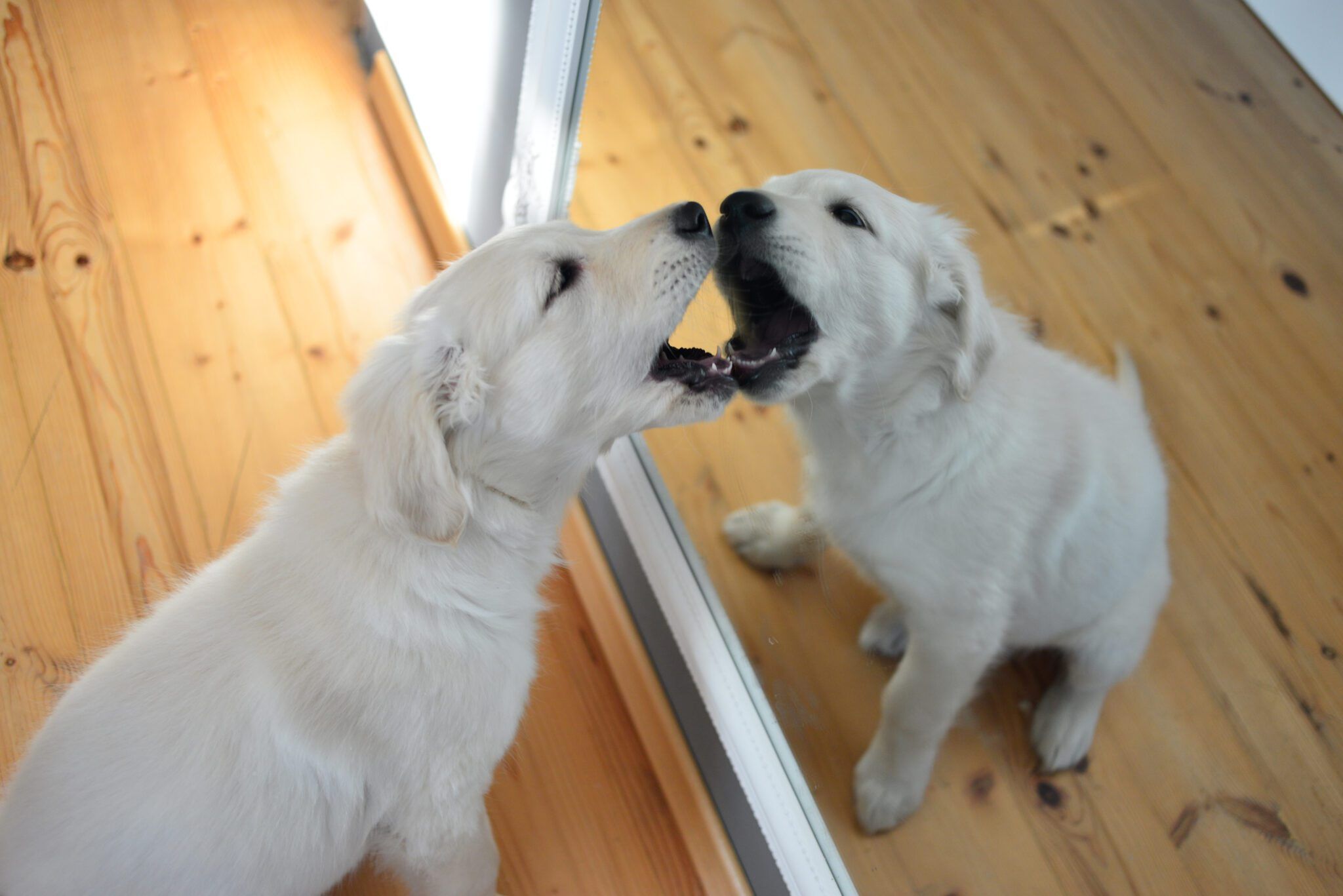
Of the six dogs I’ve adopted over the years, three of them had dramatic “who is that dog in the mirror” incidents.
There was the time a clerk at an upscale Newbury Street store in Boston nicely suggested that my black Labrador, Solly, and I leave after he caught a glimpse of himself in the mirror and had a meltdown.
Then there was the time my yellow Lab, Daisy, horrified me when she glanced up at a mirror in an elevator ceiling and suddenly started barking, snarling, and growling. I thought something demon-like was crawling above us.
Speaking of demons, the first time my pup, Macy, looked in a mirror, she made noises like she was possessed.
Why do some dogs have such distinct reactions when they see their reflections? Do dogs recognize themselves in the mirror? Do dogs understand mirrors? Figuring out the answers to these questions has been a hot topic for animal researchers.
Do Dogs Recognize Themselves in the Mirror?
Dr. Stanley Coren, professor emeritus in the Department of Psychology at the University of British Columbia and an esteemed researcher and writer about the intelligence of dogs, has his own stories about pups and mirrors. One of his favorites occurred when a friend offered to dog-sit a male Cocker Spaniel at her home.
“When she opened the door to the bedroom, the visiting dog stopped and looked at his image in the mirror and then walked over very deliberately and ‘raised his hind leg’ (urinating) on the mirror, and on himself,” Dr. Coren recalls with a chuckle.
But what was that dog thinking? Dr. Coren and other scientists have concluded that dogs do not recognize themselves in the mirror, believe their reflection is likely another dog, and eventually lose interest.
“The reason they lose interest is that the reflection doesn’t smell, it has no scent,” Dr. Coren says. “It looks like a puppy, but it doesn’t smell like a puppy, and it doesn’t interact with them the way that a real puppy would. There’s no evidence that dogs ever develop the sense that the image they’re looking at is themselves, and for some researchers, it is a very important fact.”
Important because of the ongoing discussion about whether dogs are self-aware. It’s something that scientists, dating back to Aristotle, have pondered.
Are Dogs Self-Aware?
Over the years, researchers identified three different levels of animal self-awareness.
The first, or basic, level is sentience, which means an animal is aware of their environment and sensations such as hunger and pain. Most animals have this level of consciousness.
The next level of awareness is the ability to remember and to learn from experiences.
The highest level of consciousness is recognizing oneself.
Researchers have used what’s called “the mirror-mark test” on many animal species to see whether they are self-aware enough to recognize themselves in the mirror.
In 1970, researcher Gordon Gallup Jr. tried the first test on chimpanzees.
“Chimps very quickly recognize themselves in the mirror; they make faces in the mirror, it amuses them,” Dr. Coren says.
But while the chimps Gallup was working with were sleeping, he put visible red marks (using harmless dye) on their faces.
“When the chimps woke up, looked into the mirror, and saw there was this red spot in the middle of their forehead, they recognized that that was themselves, and they reached over and tried to touch that spot because it was on their head,” Dr. Coren says.
Dolphins, orcas, Asian elephants, some birds, and fish have passed the mirror test, but do dogs pass the mirror test?
Unfortunately, as smart as our favorite four-legged friends are, when scientists tried it with dogs, they didn’t notice the spot on their heads.
Does this mean dogs do not reach the highest level of self-awareness? Are dogs conscious? Have some faith in our four-legged friends; this story isn’t over. Researchers didn’t give up.
Stumped by the dog mirror tests, scientists had an inkling that dogs just had to be more self-aware, so they tried other experiments to prove it, using one of dogs’ greatest senses: smell.
Sniffing Their Way to Self-Awareness
In 2021, evolutionary biologist Marc Bekoff, now a professor emeritus at the University of Colorado Boulder, published what’s referred to as “the yellow snow study.”
If you’ve ever walked a dog in the snow where other dogs have relieved themselves, you know how those yellow spots are golden sniffing material for a pooch.
Knowing this, Bekoff had a hypothesis, one that his dog Jethro helped him prove. For five winters, Bekoff scooped up the yellow snow Jethro marked and moved it to different locations on a trail. He also collected yellow snow that other dogs marked, moved it around, and observed Jethro.
“When his dog encountered a yellow spot made by another dog, he would pay a lot of attention to it, but when he encountered a spot stained by his own urine, he would pay a lot less attention,” Dr. Coren says. “So Beckhoff concluded that dogs do have that sense of ‘this is me.’”
Another scientist, Alexandra Horowitz, a Barnard College dog cognition expert, doubled down on Gallup’s and Bekoff’s research.
She created an “olfactory mirror” experiment using samples of a dog’s own urine and also samples of a dog’s own urine combined with an added scent. She found that the dogs spent more time sniffing the scented urine, suggesting they noticed their scent had changed, which shows self-awareness.
What is Dr. Coren’s opinion on dog self-awareness? He looks back to one of his heroes, Charles Darwin, who thought there was no reason animals couldn’t have consciousness, though it may not be as complex as in humans.
“The data has been coming out showing that dogs have an emotional range equivalent to a human toddler of about two and a half years of age,” Dr. Coren says. “Dogs don’t have the full range of emotions that humans have, but they have all the basic emotions: joy, fear, anger, that sort of thing. But dogs don’t have the complex social emotions like guilt and pride, which don’t show up in humans until at least four years of age.”
But of course, since dogs can’t talk, it’s tough to know exactly what they’re thinking.
So what does a dog think when they’re barking up a storm in a mirror, as my dogs did? Dogs having reactions like those may not seem like their most brilliant moments, but they just navigate the world a bit differently than we do.
Anyone who has ever walked a dog knows their nose leads the way as they sniff along, trying to make sense of scents. One of my friends calls it “dogs checking their pee-mail.”
There’s still so much to learn about dogs, though they seem to have a pretty good read on us, much of it through smell.
Dogs have between 100 and 300 million scent receptors in their nose, which they use to recognize not only themselves and other dogs, but also their humans. They can even sniff out our emotions, physiological changes, and even types of cancer.
Perhaps the fact that dogs don’t recognize themselves in the mirror further proves how selfless they are; they don’t need a mirror, they already know they’re quite incredible.