

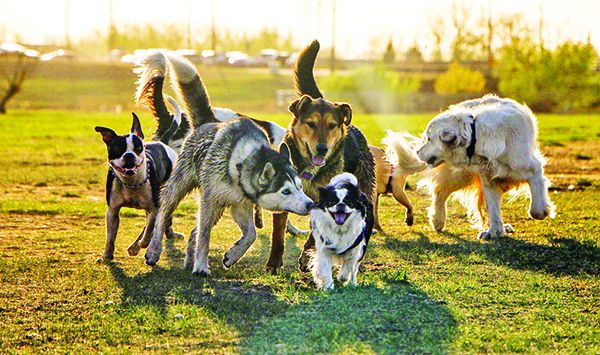
Dog parks have never been more popular. They can be good opportunities for your dog to expend excess energy and have fun with other dogs. Unfortunately, as their use increases, so does the concern about dog fights. Fortunately, there are some simple things you can do that will dramatically reduce the chances of your dog getting into a serious altercation.
1. Ensure the park has enough space.
Some dogs need a generous amount of space, especially in the context of a dog park where high-intensity play is common and group dynamics are constantly changing as new dogs arrive and others leave. Don’t go to the park when it’s busy – and be prepared to leave early if it starts to get crowded. Avoid congested areas and give more space to dogs who seem stressed or highly aroused, dogs who are playing roughly, and dogs playing with toys.
2. Observe and assess the park conditions.
It’s important to understand that your dog may be at risk merely by being a bystander, so don’t hesitate to change your plan when you get there. It may be disappointing and frustrating if you don’t go in or have to leave early because of other park users, but at least your dog will come home with both ears.
It’s impossible to predict or control the behaviors of other park users – whether they have two legs or four – but you can watch for some indicators to help determine the risk of a dog conflict occurring. Lots of dog poop on the ground can indicate that the park has many users who do not follow rules or are lax in supervising their dogs. Caregivers who are sitting or standing around chatting or using cell phones are likely to be less effective at supervising and intervening before a fight happens.
Before you enter the park, observe the dogs that are there. Dogs who are comfortable have loose and wiggly bodies. Generally speaking, dogs who are uncomfortable either look stiff, perhaps with tails held very high and hackles raised, or look hunched and lowered, with tails tucked (beyond what is typical of the breed). Avoid dogs who relentlessly follow, chase, or hump other dogs despite the other dogs’ attempts to move away.
Other red flags to watch for include dogs excessively chasing or roughhousing, dogs ignoring the calls of their caregivers, and dogs in shock collars. Dogs wearing shock collars experience stress, even when not actively being shocked, and they may be at risk of redirecting their frustration, stress, anxiety, and/or anger toward the nearest bystander.
Before setting out for the park, carefully consider if your dog is a good fit. A dog park is not the place for a dog to learn how to socialize with other dogs; there are too many things that cannot be controlled to ensure that the dog has a positive experience. And overwhelming a dog is a sure way to sensitize her further to the proximity of other dogs.
Dog parks are meant for highly social dogs who enjoy the company of all sorts of unfamiliar dogs. A dog who merely tolerates other dogs or is selective about her dog friends might do okay at a dog park – or she may become sensitized to the experience and become less comfortable.
Be aware that senior dogs and young dogs are at a higher risk of dog fights. Some research suggests that adult dogs are more likely to be the aggressor in a dog park conflict and adolescent dogs (particularly males) under 1-year-old are more likely to be the victim.
A dog’s past behavior is the best predictor of future behavior, but what about dogs with no previous experience in a dog park, or a newly adopted dog with an unknown or unreliable behavior history? Wait several months to get to know a dog before bringing him to a dog park, even if the rescue assures you that your newly adopted dog is good with other dogs.
Before your dog’s first visit to the dog park, find an opportunity to learn to recognize canine stress signals and appropriate play behaviors, and ensure you have good voice control of your dog in distracting environments. When you are out walking your dog, practice recalls with your dog on a long line.
Joining an on-leash walking group can be a safe option to assess and improve your dog’s emotions and behaviors around other dogs. You may discover you and your dog prefer private playdates with one or two familiar dogs or long-leash sniff ’n’ strolls with or without dog friends.
3. Use caution in the entrance area.
Most dog park conflicts occur within 100 feet of the entrance area, with about half of them within the first 20 feet.
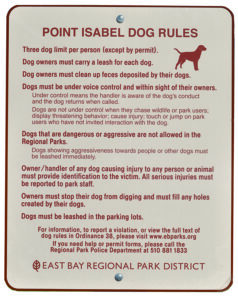
This is a high-risk zone because it’s usually congested with distracted caregivers chatting with others or looking at their phones while their dogs race around the area and mob the new arrivals. Some dog park designs make congestion worse by placing amenities like benches or water fountains in the area. Also, funneling all traffic to one entrance and exit, requiring tired dogs who are leaving to mix with over-excited dogs who are arriving, makes the entrance area a fight waiting to happen.
If possible, use an alternate entrance or exit. If this isn’t an option, do your best to wait until the congestion clears (or come back at a different time). Once through the gate, move quickly away from the entrance area and call your dog to come with you. Refrain from tossing a toy, chatting with someone, or being otherwise distracted until you are at least 100 feet from the entrance.
4. Keep your dog moving along.
Some caregivers simply enter the park and sit or stand there, expecting their dogs to play with unfamiliar or incompatible dogs. It’s better to move farther into the park immediately upon entering and continue to walk throughout the park, allowing your dog the choice to engage with, avoid, or ignore dogs along the way, and encouraging your dog to move along with you if her interactions with other dogs are unruly or uncomfortable.
Many dog professionals who are experienced in managing groups of off-leash dogs believe that conflicts are less likely to occur when groups of dogs are kept moving along rather than remaining in one area.
If you want to chat with someone, it’s likely safer to chat while you walk and keep your attention on your dog. Some dog parks are not well-suited to walking a route, such as “dog runs” or parks without a suitable substrate for walking (such as pea gravel). These types of parks are better for brief playdates with a small group of compatible dog friends or a quick romp when the park is empty.
5. Actively supervise your dog.
Effective supervision involves more than just keeping your eyes on your dog. Just like a supervisor at a school yard during recess, you’ll need to be actively engaged and focused on your dog and the other dogs in the area. A dog park is not the place to use your cell phone or catch up on your reading.
Bring your leash with you and watch for canine stress signals indicating your dog or other dogs are uncomfortable or over threshold. Even too much “happy stress” can lead to dog conflicts, especially when intense play shifts into frustration or “the zoomies” (frenetic random activity periods).
Dogs who are close to threshold will find it difficult to respond to cues, so stay attuned to your dog’s arousal levels and periodically ensure that your dog still responds to your cues. If your dog starts disregarding your recall cue, it may be time to change the activity, move to a different area, or leave the park.
It’s important to recognize inappropriate dog play and to be ready to intervene when you see your dog or other dogs exhibiting behaviors that could lead to conflicts. Just because your dog plays well with familiar dogs doesn’t mean your dog will play well with all dogs. Some dogs have incompatible play styles, and dogs who haven’t had much experience playing with unfamiliar dogs might be too rough when playing with new dogs.
Doing a simple consent test can help determine if the play between dogs is consensual or if you need to intervene: Interrupt the play and let the dog who is smaller, less assertive, or the one being chased choose to resume play or not.



Dog parks for my dogs? Absolutely not. There are plenty reasons to avoid them (all of them have been mentioned in the various comments here). I prefer planned play dates with dogs I know or dogs that I can meet beforehand and get a sense of their style of play, etc. And, I’m sorry, if I hurt feelings. But if your dog’s play style is too “pushy” and I think it would be intimidating for my own dogs, no play date. When having a play date with a dog my dogs don’t already know, we keep everything on leash at first, and try taking a walk together at first so the dogs can gauge each other. I’m a huge fan of letting dogs have play mates and letting them meet other dogs. I’m just a fan of doing it wisely, where the chance of any aggression or anyone being hurt is minimized.
I regularly take our 10 month old golden retriever to the local dog park. The “regulars” are great at suggesting how to help control and monitor your dog. If there is an intact dog brought in, we leave. If there is an aggressive dog, we leave. We help keep the park clean by picking up poop we find that someone either missed or ignored. This park is a major asset to our community. The people and dogs who use it to run and play help each other and newcomers with appropriate use. Normally we don’t go there on weekends. We consider this a supplement to regular walking and hiking with our pup.
I agree there’s a time and place for dog parks. I’ve only been to 2 ,one while traveling and my border collie refused to go in with the big dogs, he would only go in on the small dog side and then he just stood there by my legs. My traveling buddies cattle dog went in with the big dogs and did play.
During the Caldor fire evacuation I took both my boys, the border collie and a pug mix to a local dog park because we were pretty restricted where we were evacuated as to where they could run off leash. Anyway at that dog park things went fine until someone came in with a new adopted dog and a pocket full of treats because he was going to train it! Needless to say my pug was right on his heels on the side where the treat bag hung and that was the end of that trip. I guess they have their uses but I must say I’m very reluctant to trust other folks and other dogs. My border collie‘s very sensitive to almost everything, and my pug cross loves everybody and everything. So you can see my conundrum . I don’t think people should say nobody should go to a dog park, I think that’s an individual decision.
Great advice! Thank you Whole Dog Journal..My dig was attacked outside a dog park when I was responsible my dog on leash and someone with a big reactive dog off leash..be safe
Oberly what people call ‘sociable’ these days dogs are also a problem. The young dog and it’s owner should know when the dog is invading another dog’s personal space. The best way to get around this is NOT at a dog park with strange dogs and then claim that your dog is socialised, get your dogs to learn from oldern ‘known’ dogs in the family… My 1.5 GSD learnt bite inhibition and knowing his personal space from my 4yo lab. People think this should happen at a dog park – most certainly not, it will cause fights.
ALSO** NEVER do on leash greetings at a dog park, this is so silly, the dog will fear that the other dog is either in danger or will rough house if they can’t greet eachother properly.
I also noticed your article mentioned ‘Hackels’ or raised furs on a dog, some dogs cannot help this, it just means they are aroused/ excited/ scared or all of the above.
I’ve never taken my dog to a dog park. There is one close to our subdivision and one of the small dogs was killed in that dog park. I would never let my dog be in a dog park. I’d much rather invite some of our neighbors’ dogs to play with our dog in the backyard.
I have an Akita who goes into drive virtually whenever he sees another dog big enough to potentially challenge him.
I hated having to neuter him, having prejudices of my own re: impact of neutering on hip socket development. However, he is strong and can pull me off my feet when he is in drive. Reluctantly, I neutered him at two years. The effect took several months – but although he still goes into drive when he sees a potential competitor, I can now snap him out of it. I use a prong collar, and that helped immensely also.
For a dog originally bred to hunt large game, the walk IS the equivalent of the hunt. Such a dog will instinctively seek to enlarge his hunting territory. Interlopers are to be driven away. Nothing you can do about it.
The roots of this behavior: in the snowy wastes where THIS particular breed was developed, there is sparse game. A five square mile area is barely enough to provide enough forage over the winter for the prey animals. Once you’ve got your hunting area secured, it is a matter of survival for the dog and his pack to keep other hunting animals out of it – it is resource guarding at its most elemental.
Hence, our walks consist of quadrants surrounding our home. One quadrant for each 50 minute walk over the course of the day. Much sniffing and territorial marking.
I have had this breed for forty years, and would not have another. They are fabulous engineers’ dogs – they are quiet, fastidious, and have an eerie degree of perception about your priorities, plans and moods. They remember slights for YEARS. They also remember anybody who admired them as a puppy. They are said to be one-person dogs. My Akitas individually have been so much dog that I would not have had the bandwidth for more than one, even when I was younger. Particularly since at that time, I was raising a family and commuting to work.
I will not ever take him to a dog park, or to doggie day care. IMHO: from his viewpoint, there would be too many potential competitors for the available hunting territory (dog park, day care place) from his viewpoint. As well, I know deep in my bones that if any of the others were to approach him rudely, he would correct them.
We don’t do dog parks, although I wish we could. Greyhounds a lot of times don’t like them. My first hound would always end up with some disease after we went to one, so we just said forget it. My Kori is rather alpha and can get snarky with other dogs, I don’t want to risk that either. So pass!
Jeezus a lot
Of these people sound so
Scared of
Dog
Park’s! ridiculous !
I agree with other commentors. It’s not a place that responsible dog owners take their loved ones. Because we know that the irresponsible ones will be there, which means issues and no control.
I’ve heard the “Oh hi, my dog’s name is … I brought him here to teach him how to socialize after he attacked a dog last weekend. I think the socialization will do him good. The shock collar is just a precaution. He responds to it about 20% of the time. “. I even heard a lady say she was going to put a shock collar on her dog inside out as protection. omg people! No!
And rules aren’t enforceable. Except for license/tags. Most of the parks here have no water (they do in the kids playgrounds though). IMO it’s the most irresponsible place ever to take a furry loved one.
If you think your dog park is somehow magically immune because of whatever reasoning, then you’re not thinking with logic. The only statistic that will hold true is the more times you visit a public dog park, the more likely an issue.
And if you frequent the park but aren’t hearing the stories.. it’s because once your dog has been subjected to trauma you won’t be going back to tell the story.