

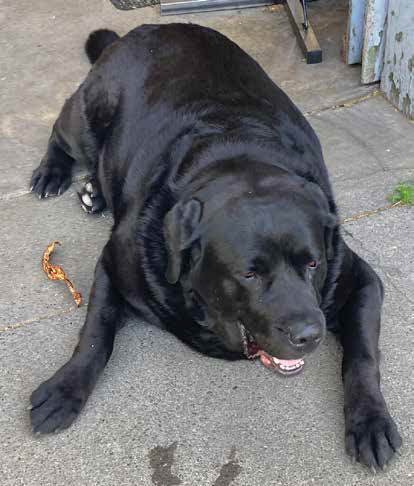
Our dogs’ food intake and access to exercise—and thus, their body weight and condition—are completely up to us. We control what they eat and when they get exercise. When our dogs are overweight, or fat, it’s our fault. Sadly, obesity has become a primary concern in veterinary medicine, just as it has in human medicine.
Why Does it Matter if My Dog is Obese?
Here’s why: Dogs who are maintained at a healthy weight have a lower risk than fat dogs for many life-threatening health problems, including diabetes, kidney disease, metabolic and endocrine disorders, hypertension, and some cancers. Older dogs with arthritis can remain ambulatory and active much longer if they are slender. Dogs with lean body mass have fewer injuries to bones, muscles, and tendons than dogs who carry excess weight. Studies have shown that fit dogs live, on average, about two years longer than overweight dogs.

Why Does it Matter if My Dog is Obese?
Here’s why: Dogs who are maintained at a healthy weight have a lower risk than fat dogs for many life-threatening health problems, including diabetes, kidney disease, metabolic and endocrine disorders, hypertension, and some cancers. Older dogs with arthritis can remain ambulatory and active much longer if they are slender. Dogs with lean body mass have fewer injuries to bones, muscles, and tendons than dogs who carry excess weight. Studies have shown that fit dogs live, on average, about two years longer than overweight dogs.
Find Out What Your Dog Should Weigh
Start by getting an accurate, honest assessment of your dog’s condition. Make an appointment for your dog’s annual health examination. At that visit, let your veterinarian know that you are concerned about your dog’s weight and want her professional opinion: How much should my dog weigh, ideally?
Many veterinarians are gun-shy when it comes to bringing up this topic with their clients; it makes many people defensive! But if you ask your vet for her opinion, and remain open and receptive to her answer, you just might learn that she’s been keeping her true opinion about your dog’s condition to herself. If she hesitates or waffles at all, ask a different question: “Do you think he should lose a little weight?”
Determine What Your Dog Weighs Now
Using the scales at your vet’s office, get an accurate weight for your dog. Write it down, along with the date. If you have a dog small enough to hold, you can also do it at home by stepping on the scale with and without the dog and doing a little subtraction.
Calories Count in Dog Diets
Don’t figure on a major weight loss all at once. That’s not healthy. Aim for a weight loss of 3% to 5% of your dog’s body weight per month, or 1% per week. A 50-pound dog should lose about half a pound per week, or 2 pounds per month.
How Much to Feed a Dog to by Weight
The number of calories your dog should be fed to maintain her ideal is referred to as her “resting energy requirement (RER).” To determine your dog’s RER, convert her ideal weight in pounds to kilograms by dividing by 2.2. Then multiply that number by 30 and add 70.
Say I have a dog who weighs 100 pounds, but who should weigh about 90 pounds. Ninety pounds divided by 2.2 is 40.9 kg. Now I multiply by 30 and add 70:
40.9 x 30 = 1,227 + 70 = 1,297
1,297. That’s how many calories per day I should feed the 100-pound dog whose ideal weight is around 90 pounds. Now go check the number of calories in the food you give your dog. The food my dog is eating right now contains 380 calories per cup. So, I’ll divide the number of calories my hypothetical fat dog should be getting by the number of calories in each cup of food:
1,297 ÷ 380 = 3.41 cups of food
“But wait!,” you say. “On the label of the food I feed my dog, it says I should be feeding a dog who weighs between 75 and 100 pounds between 4 3/4 and 5 1/2 cups of food per day!”
What can I say? That’s probably how your dog ended up overweight! The sad fact is that most dog food labels overestimate dogs’ RER. They generally cover for this by adding the note, “Adjust feeding for optimal body weight.”
The moral of my example: Look at your dog’s food label to get the caloric content of the food and calculate how much you should be feeding him based on his RER.
This amount may need to be adjusted in some cases. Dogs who are substantially overweight may do best with an interim target weight (rather than their ultimate ideal weight) to start with. Very active dogs may require up to 1.4 times their RER to keep their weight loss at a safe rate of no more than 5% per month. Puppies who are 4 months and older may need as much as two times their RER.
Of course, this addresses only the dog’s basic diet. If you feed a lot of treats, check the caloric content of the treats and reduce your dog’s food by about the amount of calories you are feeding him in treats. Because dog foods are complete and balanced and treats are not, however, you shouldn’t replace too many of his food calories with treats.
Hint: Most dogs care more about the number of treats they get than the size of each treat. It’s more rewarding for a dog to receive several small treats than one big one. Using tiny treats will help you reward your dog without adding too many extra calories.
Weigh Your Dog Frequently
It is critical you weigh your dog regularly. Especially when first starting a weight-loss program; start by weighing your dog once a week. If your dog is too heavy to pick up, you’ll need to go to your veterinarian’s office to get an accurate weight.
Once your dog begins losing weight steadily, you can go longer between weigh-ins but recheck at least twice a month to make sure you’re still on track. It’s easy to slip back into giving too much food and undo much of the good you’ve done if you rely solely on how your dog looks and feels. By the time you notice a difference, your dog could have gained a lot of weight back.
Increase Your Dog’s Exercise
Regular exercise is essential to a successful weight-loss program. Proper exercise not only burns calories, but also helps burn fat and build muscle, improving body condition. As your dog loses weight and gains muscle, he will feel better and become more active, which will speed up the weight-loss process.
If your dog is not used to exercise, don’t do too much too soon. Start with short sessions tailored to your dog’s capabilities, such as on-leash walks that gradually lengthen as your dog’s exercise tolerance increases. Don’t exercise your dog to the point where he is sore afterward. Non-weight-bearing exercise, such as swimming, is ideal for dogs with joint problems and for other dogs as well. Again, start slowly, using a dog life jacket if that helps him to feel more comfortable in the water.
If your dog is older or has health problems, consult with your veterinarian before beginning an exercise program. If your dog is reluctant to exercise, it could be a sign that something’s wrong. A trial of pain medication can help you figure out whether your dog’s lack of activity is related to discomfort.
Help Your Dog Reach a Healthy Weight
Your dog may not be happy about his new diet at first. He may start begging, counter-surfing, and even going through the kitchen trash, looking for a few extra calories. Give him a carrot to munch on. Soon enough, as you begin to spend more time with him walking, and as his body begins to feel lighter and less burdened with all that extra weight, he’ll start to enjoy those walks more and worry less about how many kibbles are in his bowl.

ihad my little jackpot diagnosed heart failure suddenly started thinking of losing him rwo episodes breathing heavy all day one stayed overnight i no longer let him have egg in slice of bacon use coco oil lightly to take his meds in hard yoke trying to raw diet and different kibbles sprinkle crushed mag calcium zinc d3 vit e fish oil had anti biotic to see if he would chew a bone if it was infected gums i have read that animals have ability to rejuvenate i believe it he has become happy little guy again not as energetic but close still taking meds after 1 year 150.00 month he may still have heart failure but at 7 yrs hoping to have quality of life. vet said it wouldnt happen but i changed everything he ate i think it worked out for him he wouldnt eat before now anxious for dinner.seems like a miracle to me
After a very expensive operation (twice) to repair a broken hock, I decided, along with the vet that it was time to help our Callie lose weight. It took several months being diligent and with an Exel chart to take off 10+ lbs. She is more lively and looks forward to her moring walks of a mile.
I created the chart, listing everything she would eat during the day including what her total calories were. Nineteen Columns.
Day, Date 2022, TIME, 3 MEALS, Purina Pro Plan Low Fat 6.7 oz = 181.6 Cal, Home-cooked Dog Food 2.5 oz = 106.3 Cal, Wet Trky. Dck. Stw 1.3 oz = 33.2 Cal, Wet Bf, Lmb, Bsn .2 oz = 31.9 Cal, Instnct Lamb Dry 1.0 oz = 123 Cal, Instinct Lamb w/wet 1.7 oz = 209.0 Cal., Pumpkin 0.4 oz = 4 Cal., Vitamin 1= 14 Cal., Treat 1 = 21.2 Cal., Pil. Pkt 23 cal,
Blue Berry treat 1 = 6 Cal., Mlk Bone Dntl Chw 1 = 100 Cal., Benefal treat 1 = 24 Cal., MEAL TOTAL, DAY TOTAL CALORIE., WEEK DAY AVERAGE.
I keep her at about 350 calories per meal. As you see there is a column for different foods. I switch her around so meals wont be so boring. She has been on this schedule for 74 weeks now and has been holding at 73-74 lbs. She is a standard golden doodle. I do keep a kitchen scale and use it for all three meals.
It’s helpful to keep the time that she eats, because (we’re in our late 80’s) either my husband or I fix her meal, we know how long or short a time it was that she ate before. She has never passed up a meal and eats all of the food. Before this, we used to fix her meal and she may or may not want to eat it. We would have to cover and set it in the frig. Now she cleans her “plate”. 😊
Great article! Thanks for the calculations as well. My vet always says that my springer spaniel is about 5-10 lbs overweight. The math equation was great to see if I was feeding him correctly for his target weight. The pictures are great as well. Thank you!
Many years ago I had a cairn terrier who was overweight. I was sort of aware that Annie was too heavy but pretended to myself that she wasn’t. Then, one day when we were walking in our neighborhood, a woman who stopped to pet Annie said, “Your dog has such a cute face, and a little piggy body.” That was my wake-up call. It was time to take action. I increased the distance I walked Annie, decreased the size of her meals, and bought a digital bathroom scale so I could monitor her weight (weighing myself both while holding and not holding her). It took about a year for Annie to reach her ideal weight, which she maintained for the rest of her life. I never saw the woman again but have always been grateful to her for speaking the truth.
I forget who I first heard this weight assessment technique from, but this “touch assessment” advice works well for me to assess the weight of my own dogs and not have to go into the vet’s office frequently to get on a scale. I advise my clients to use the “touch test” for ideal dog’s weight. Ideal weight – you should be able to lightly stroke the side of your dog and easily feel rib bones, press lightly at the shoulders and top of hip / butt bones and feel the bones with only light pressure. Obviously, seeing the spine protruding and / or visually seeing a lot of rib definition is too thin. Seeing some visual of a rib bone while a smooth-coated dog is in motion, may fall into the area of “ideal weight”.
Your calculation of RER is what got the obese rescue Berner I am now working on fat to begin with….it is important to note that feeding even the RER calories with no movement or exercise will result in fat as well. I have dramatically cut this dog’s calories while increasing swimming exercise to begin getting what amounts to 60-70 lbs he needs to lose in total. He has lost 30 so far this year.
What if you feed raw and bones as I do. I feed 6oz cube of raw ground meat (beef or tripe or offal) along with a frozen ducks neck or a piece of a Pork brisket bone. I sometimes include a spoonful of 3% fat greek yogurt and some leftover veg from our dinner. Is that too much? he doesn’t seem to be losing any weight. He is a 4 yr old Lab/Doberman mix who weighs 86 lbs. He weighed 87 lbs a couple of months ago so I guess I am making some progress but very slowly.
Is your dog eating anything aside from what you have listed? Vet opinion here—I would be concerned he is not getting the proper nutrient profile from what is listed. That could be the issue. Home cooking and feeding raw can be a very challenging project! Consulting with a vet nutritionist (ACVN) could potentially help in this situation. Another option is to use the balance it.com website. Best of luck. 🙂
We adopted a 9 year old English Lab/Mastiff mix who weighed 115 lbs. when we adopted him (down from 119 lbs. when he was surrounded). I immediately cut down on his food (he was getting 2 big horse scoops of food a day), and added green beans. We also started walking short distances, increasing as he was able to go further. At his best, we were walking an hour and 20 minutes a day (not all at once). He got down to 80 lbs. and looked magnificent.
Sadly, the extra weight left its mark. He had hip dysplasia, arthritis, and his spine deteriorated to the point to where he could no longer stand, and we made the tough decision to euthanise him at 13.
If his previous owner hadn’t over fed him, he would probably have lived a much longer life.