
[Updated June 15, 2018]
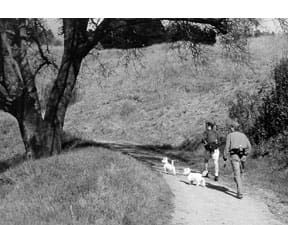
If you spend your time in the company of dogs, you’re probably used to walking – long walks, short walks, walks for potty stops, walks for exercise, walks to relieve boredom, and walks for walking’s sake. So, what’s the difference between walking and hiking? In practical application, not much. But in attitude, everything!
Think of hiking as an adventure, getting wild, and leaving the mainstay of human existence – even if only for a few hours. And sharing the hiking experience with a dog offers rewards beyond explanation.
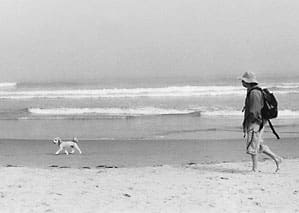
I’ve heard people warn that hiking with a dog scares off the wildlife, that you’ll see or hear less. In my experience, hiking with dogs brings me deeper into the adventure.
Recently, I was walking with my dog friend, Jesse, through a wilderness area on the edge of our city. As we were passing through a large meadow, I was distracted by the views of the ocean. But I noticed Jesse’s stance change. She air-scented for a moment, then the set of her ears shifted. I looked in the direction of her ear set. Her eyes followed mine. At that moment, I saw him, about 100 feet away – a beautiful young coyote. He’d been watching us, but I hadn’t noticed.
Jesse and I both stood still, eyes fixed on the coyote. When the coyote realized he had a captive audience, he began dancing through the tall wildflowers. He did not approach or retreat, but instead he rolled on his back, spun circles, made playful leaps into the air. It appeared as though he was inviting Jesse to come and play.
Jesse watched with interest, but stayed calm next to me (thanks to the leash!). After a few minutes, the young coyote must have decided we weren’t going to play and gave up his antics. He headed past us through the meadow and disappeared into the tall grass. We also continued on our way, but that experience – one that I would have surely missed if not for my dog friend – is forever etched in my mind.
Prepare Your Dog for the Woods
If you’ve never hiked with your dog, but are thinking of trying it, you are in for a lot of fun. You may want to start out with a casual adventure – close to home and not too long. I’ve witnessed a few city dogs who became nervous when walking in the woods for the first time. But by making the experience fun (bring along lots of great treats or your dog’s favorite toy), you can assure that he’ll soon overcome his nervousness and be as excited about hiking as you are.
Even for those dogs who obviously love the great outdoors, be sure to choose an adventure that suits both of your abilities. Think about the kind of physical condition you are in, and how adapted you are to the altitude, the outside temperature, and the terrain. For example, a dog (or person, for that matter) who lives and hikes regularly along the coast may have a tough time when hiking in higher altitudes. Likewise, a dog from a cool region may have some trouble in the heat of a summer desert. Muscles that are well suited for level or gently climbing trails may tire much faster on a steep climb. Don’t try to go too far or climb too high if you or your dog is not up to the challenge.
Finding the Right Dog Trail
Finding a great place to hike with dogs can sometimes be a challenge, especially if you live in an urban or other populated area. Many places that offer great hiking are off limits to our dogs. Some areas will allow dogs, but only on certain trails or at specific times of the year. But places to hike with dogs are out there – you just have to look!
Probably the best way to find fun hiking spots is to talk with other people who like to hike. Ask your friends, or the folks who work at the local outdoor equipment store or feed store. You can also search through hiking guidebooks – there are dozens in most libraries and bookstores. Some say if dogs are allowed in the area, and sometimes they even include leash restrictions.
You can also check online resources. A quick search for “Hiking in Santa Cruz,” for example, came up with a few great sites, complete with directions to the trailheads and maps of the area. Once you’ve got a place in mind, double-check the dog rules. It’s disappointing to get to a trailhead only to discover that an area that was once open to dogs is not anymore.
Here are a few additional tips for your search. National Forests can be a gold mine for hikers with dogs – dogs are allowed on most trails, and are often permitted off leash. National Parks, on the other hand, are usually less dog-friendly and rarely allow dogs on trails. Other places to check are local wilderness areas, county parks, and state parks. Rules and regulations vary dramatically from place to place and park to park, so call ahead to find out the specifics about dog regulations.
Leave Only Paw Prints
Hiking with dogs has become an endangered activity in some areas. More and more places are restricting access for dogs. The reasons may be obvious. Wilderness areas are shrinking, the population of people and dogs is ever-growing, and the places where the two meet have become more congested. Those of us who love the great outdoors are rightly concerned about the well-being of our wilderness areas, and about the future of hiking with dogs. So what can you do?
Respect wildlife and help your dog do the same.
If your dog enjoys a good chase, keep him on leash! While a wild animal is likely to outrun a domestic dog (though not always), your dog’s chase could leave the animal tired, and much more likely to become another’s dinner. Also, the animal or bird may be an overworked parent, foraging for its young. Using its energy resources to escape your dog may cause it to fail to provide food for its vulnerable babies.
Try to have as little impact on the area as possible.
Pack your trash. Scoop your dog’s poop and carry it out. Try not to disrupt plants and other natural features. Use special care not to pollute water sources, too.
Act as an ambassador for all dog people.
Always follow posted guidelines and rules for dogs. It’s hard to remember, but not everyone likes dogs! It could be terrifying for some people to have your dog bark and run
up to them on the trail – or just plain rude to allow your wet, dirty dog to crash some other hiker’s picnic lunch. Help others see that those of us who hike with our dogs really care about others and the wilderness. We want to see it remain available and untouched for all to enjoy — dogs included!
Respect the wilderness as a precious and fragile treasure. “Take only memories, leave only paw prints.”
The Hiking Dog Basics
When you’re heading out for a hike – whether it be a quick romp through your local woods or an all-day adventure – remember this rule of thumb about what to bring: If you need it, your dog will likely need it too. For even the shortest of hikes, you will probably need to bring a few basic items:
A Leash
Of course. Even if the area is open to off-leash dogs and your dog is reliably responsive to your voice control, you may need a leash under certain circumstances (like if you run into a skunk on the trail and don’t want your friendly dog to investigate).
Identification
Your dog should always wear identification, with your contact numbers and, if you have traveled far from home, the best number to reach you locally. (See “Proper Identification Tags,” WDJ October 2001 for sources of permanent and temporary identification tags.)
Plastic Bags for Scooping Poop
If you’ll be a distance from a trash can, take an extra, heavy duty Ziploc bag for double-bagging so you can stash the goods in a pack.
Water for You and Your Dog
A hiking dog may need to drink two to three times as much as he does when hanging out at home. Give your dog drinks of water frequently when hiking. Use caution not to wait until your dog is so thirsty that he’ll want to drink too much, too fast.
Note: It’s not a good idea to let your dog drink straight from streams, rivers, or lakes as many harbor waterborne diseases such as giardia. If it’s not safe for you to drink, it’s probably not safe for your dog.
Snacks and Training Treats
I get hungry when I hike so I bring raisins, cheese, apples, and other yummy snacks. My dogs are always hungry, but they get a bit more so when hiking too. I like to give my dogs’ their hiking snacks as rewards for sticking close and coming when called.
First Aid Kit
You may not need to bring a first aid kit for a short walk in a local park or close to home, but for longer hikes and wilderness adventures, a first aid kit for you and your dog is a must.
In addition, you may want to have a few items stashed in your car, for those “just in case” moments. If your dog enjoys romping through puddles and creeks, or is likely to roll in that delightfully smelly something, grooming supplies can make the ride home a little more pleasant for the human half of the team. I like to bring a couple of dog towels, a jug of water, and a comb and brush. That way I’m prepared for Blue’s mud baths and Jesse’s odoriferous rolls. Plus, I’d rather leave the ticks and burrs at the trailhead than carry them home in the car!
Other Gear and Gizmos
While the “basics” above will be enough for many adventures, you may want to consider a few additional items:
Dog Booties
When I think about hiking, especially long hikes, I think about how to avoid blisters on my feet. My dog’s feet may need protecting, too – especially if I’m hiking over rough surfaces, hot sand, or through the snow.
Dog booties come in a variety of sizes, styles, and materials and it’s important to pick a type that will be both easy to put on and appropriate for the elements. Nylon or neoprene booties that fasten with Velcro are easy to get on and off your dog. Look for booties with heavy duty soles, such as those made with Cordura. Leather booties lace up and are a bit of a task to get onto a dog’s paws, but may hold up well in seriously rough conditions (like traveling over shale or volcanic rock). Polarfleece may be a good choice in cold and snow. (For a review of dog booties, see “The Best Boots for Your Dog,” WDJ January 2001.)
Dog Packs
Many dogs love carrying packs. Most dogs who weigh more than 30 pounds can safely carry a pack. Hip dysplasia, back problems, and other health issues can make packing unsafe for some dogs, so if your dog has any health problems, it’s a good idea to check in with your veterinarian before fitting your dog with a pack.
Dog packs come in different sizes and styles, from daypacks to heavy-duty mountaineering packs. If you’d like your dog to pack his own stuff, you’ll want to train him to wear the pack before you head out on the trail.
Get your dog used to wearing a pack:
Most dogs love wearing packs once they get used to them. Strutting down the trail on hikes or backpacking trips, your dog can help lighten your load. Dog packs come in a variety of styles, from daypacks to heavy-duty mountaineering packs.
Just how much weight can a dog carry in a pack? Most experts suggest that the average dog not carry more than about 10 percent of his body weight. Packs vary in size from small to extra large, and should be carefully fitted to your dog. And, as with people packs, the more padding they have the more comfortable they will be for long treks. Many packs have padding along the saddle and the straps. Here are a few additional tips to
ensure comfort and safety.
The pack needs to fit properly. It should ride high on the dog’s shoulders and the straps should be snug but loose enough so that you can stick your finger between the strap and the dog’s body. Your dog should be able to move his legs freely, and he should be able to lie down in the “Sphinx” position without the pack touching the ground.
Balance the pack. If your dog is carrying his food, for example, divide it into two bags and put one on each side of the pack. Also, pack heavy items near the bottom and lighter items near the top.
Use plastic bags to protect items that could be damaged by moisture. Dogs always get wet when you don’t expect them to.
Spending a little time getting your dog used to wearing a pack before you hit the trail will pay off with a happy hiker:
Make the experience fun. The first time you show your dog the pack, have a handful of treats in your pocket. Place the empty pack across your dog’s back and focus his attention on you. When he stands for a moment with the pack on, give him a treat. Then take the pack off and repeat the process. When he stands easily with the pack on his back (for some dogs this happens after a few times, for others it can take 10 times or more), you can go on to the next step.
Fasten the empty pack securely around your dog and take him for a short walk in a safe, comfortable place. This could be around your neighborhood or even in your backyard. If your dog is at all hesitant about the pack, continue to feed him treats and keep his attention on you. Repeat this a few times until you are sure your dog is comfortable with the pack on his back.
When your dog can walk comfortably with the empty pack, start adding light items. At first, put in soft items that won’t shift around with the dog is walking. Gradually increase the weight in the pack until your dog can easily and happily carry 10 percent of his body weight.
Watch out. Once your dog is a happy hiker and packer, he may start subtly suggesting that you take longer, more adventurous hikes – or even head out on a backpacking trip.
Collapsing Water Bowls and Handy Bottles
I love those collapsing water bowls, the kind that fold or twist and can be stashed in a pack. And the water bottles with built-in bowls for dogs to drink from? Very cool. In a pinch, however, you can use an extra plastic bag; simply roll down the sides for an “instant” bowl.
Protection from the Elements
Being too hot or too cold can be dangerous for people and dogs. Be sure that you are both prepared for the expected conditions – and if you’re going more than a few miles, make sure you are prepared for the unexpected, too. For example, if your dog needs a sweater or coat for cold days at home, take one along on your hike if the conditions warrant it. If you’re taking a long hike or backpacking in extreme conditions, check into a lined parka with a waterproof shell for your dog; she’ll appreciate it.
In addition, be sure your pooch doesn’t overheat on your adventure. Keep her cool by wetting her down.
Wildlife Encounters on Hikes
I’d like to say that every wild animal encounter will be as pleasant as the day Jesse and I spent a few moments in the company of the coyote. Most are, but there are exceptions, and “better safe than sorry” is a code all hikers should follow. Certain wild creatures can pose a real danger to you and your dog. It’s not just the big animals (like mountain lions and bears) that can be trouble, either. Some of the biggest risks come from the smallest beings.
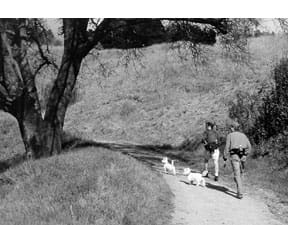
Ticks, spiders, and other things that crawl can certainly be trouble for dogs. In many states, for example, ticks carry Lyme’s disease. In other areas, they may carry Rocky Mountain spotted fever. If you’re hiking where ticks live, check your dog frequently and remove any that you find. Some places are home to black widow or brown recluse spiders, both of which can be dangerous to dogs. Most snakes, scorpions, and toads are not harmful to dogs (your dog will generally pose more of a risk to them!), but there are a few exceptions. Rattlesnakes, copperheads, cottonmouths, and coral snakes, for example, can all be dangerous to dogs.
Perhaps I don’t need to mention the problems with a dog running into a skunk? But in case you haven’t considered it, just imagine the car ride home if your dog does decide to investigate a skunk.
Wild dogs, mountain lions, and bears are all serious concerns. If you are traveling in an area where these animals live, it is imperative that your dog is with you and on leash at all times.
Small furry creatures, like gophers, squirrels, and mice, will generally be in more danger from dogs than the other way around, as will deer and elk. Don’t allow or enable your dog to chase animals – for his safety and theirs. A simple chase, even if your dog is not likely to catch or hurt them, can tire an animal, making it an easier target for another predator. A dog chasing any animal can easily become lost – many people have permanently lost their dogs in this very way. And a dog who becomes accustomed to chasing every animal he sees is likely to cause a serious accident someday, when he encounters someone on a horse.
Along with taking care around animals, you’ll want to be aware of other natural features that may pose a hazard to you or your dog. For example, fast-moving or very cold water can also be dangerous. And some dogs are oblivious to the risk of cliff edges; keep them close to you.
If the area where you hike features poison oak, ivy, or sumac, take special care to protect yourself. Dogs seldom suffer the itchy, painful rash associated with these three plants. A more realistic fear is that your dog will play in the poisonous plant, and the oils will get on you when you pet him.
The rash that humans get from these infamous plants is caused by a chemical called urushiol, which is present in the plant’s leaves, bare branches, and even its roots. Under hot, humid conditions, the poisonous oil becomes harmless in about a week. However, under dry conditions, the oil can retain its harmful effect for as long as six weeks.
If you are particularly sensitive to the rash, keep your dog away from these plants, even if it means keeping him on leash for the entire hike. If he does romp through the plants, try not to touch him until you’ve bathed him, which you should do as soon as possible. Use a soap (like Fels Naptha laundry bar) or a commercial solution formulated to cut the oil, and wear rubber gloves and protective clothing.
Hiking is Habit-Forming
Don’t be scared off by all of these words of caution and hints at possible dangers. In the 25 years I’ve been hiking with dogs, I’ve only encountered problems a handful of times, and none was terribly serious.
Still, it’s good to know what might be there, so that you can take the simple precautions needed to protect yourself and your dog. If you’re new to hiking or traveling to a new area, how do you find out what animal, plant, and other natural dangers might be found along the trail? Many trailheads have signboards that will update you on animal sightings and any special dangers.
If the area you are visiting has a ranger station, you may be able to call ahead and ask. You can also quiz people who have visited the area and look in the guidebooks. If these options aren’t available, simply be aware of your surroundings and use common sense.
Hiking is, in my opinion, one of the most wonderful experiences you can share with a dog. Traveling down a trail together lets you share the adventure and fun. Plus, when hiking with a dog, you will get to see the wilderness through different eyes – your dog’s. Pay attention when her ears go up, or when she lifts her nose to the wind. Her canine curiosity may lead you places you would never go on your own.
Get more information on planning the best hike for your dog at Dogster.com!
For more information on hiking, backpacking, camping, and other outdoor adventures with your dog, check out Ruffing It: The Complete Guide to Camping with Dogs, by Mardi Richmond and Melanee L. Barash. The book includes what-to-bring checklists, tips for getting your dog into shape for long hikes, a complete first aid section tailored to outdoor adventures, and much more.